Loading…
Loading…

MONTSAME
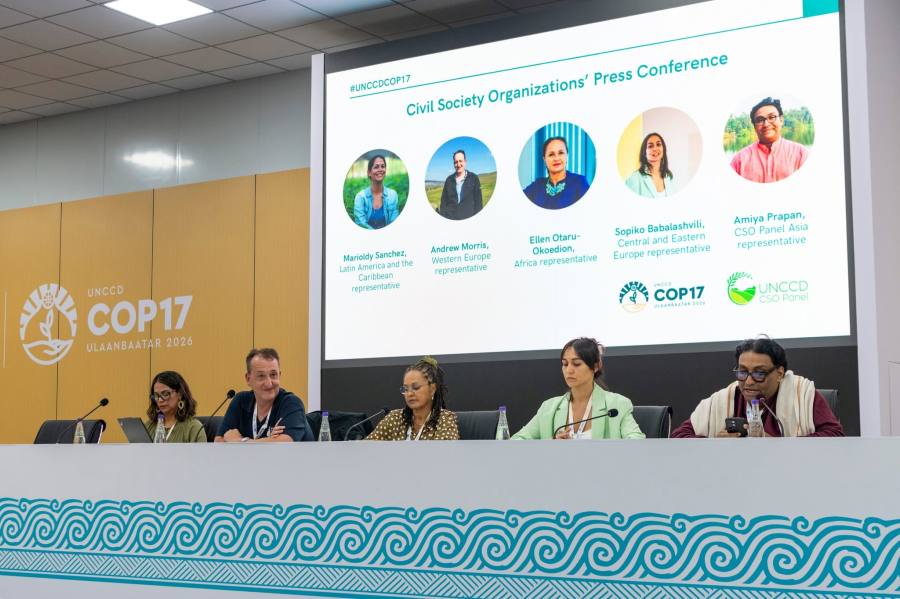
ULAANBAATAR, August 17, 2026 /MONTSAME/ UNCCD civil society representatives from five regions presented the civil society priorities they intend to bring to COP17.
Marioldy Sánchez (Latin America and the Caribbean):
 Civil society organizations play a crucial role in ensuring the convention's implementation. CSOs work directly with local communities, farmers, and small enterprises, helping translate the convention's goals and objectives into real life. On top of that, they serve as an important bridge, connecting native groups and their needs and views of communities to global programs, policies, and targets.
To ensure civil society participation in implementing the convention, the panel was made up of five members representing the five regions that will be in operation. Members are appointed every two years, and their main role is to coordinate the positions, views, and participation of civil society organizations between COP sessions. Since taking on this role last year, we have worked together to define the key civil society positions for COP17. In doing so, we listened to the views of civil society organizations across all five regions and created various mechanisms to ensure their participation, allowing us to reflect the realities on the ground, the voices of local people, and the particularities of each region. We will present these messages during COP17. We are also ready to work with the civil society organizations taking part in this COP and to support all stakeholders. Above all, to turn the convention's goals into real results, we must focus on the implementation stage.
Andrew Morris (Western Europe):
 For me, the most important thing I expect from COP17 is not only setting new goals and commitments. But moving them into real implementation. From a civil society perspective, making implementation real requires securing sufficient financing and getting it to local communities. That is when the convention's objectives are truly realized. Beyond intergovernmental cooperation and the exchange of knowledge and experience, we also need to bring together the knowledge of scientists, indigenous peoples, local herders, farmers, and other stakeholders.
Civil society participation is vital in connecting all of this and carrying stakeholders' voices into policy and decision-making. COP17 is therefore an important opportunity—not to redefine goals and commitments, but to make concrete progress on real implementation, financing, and local-level participation. Broadly, we need to combine indigenous peoples and traditional knowledge with technological advances. There is immense knowledge and information at the local level, so we must connect and integrate indigenous traditional knowledge with scientific knowledge and research. We also carry out evidence-based advocacy. The mechanisms civil society has built will help drive change among domestic stakeholders and strengthen their participation and capacity.
Amiya Prapan (Asia):
 Civil society organizations have identified several interlinked priorities. First, ensuring safe and equitable access to land. In particular, the land rights and participation of women, indigenous peoples, and local communities must be supported, alongside participatory land governance and sound land-use planning. Second, setting more ambitious, forward-looking targets and frameworks. Implementation must be sustained not only for today but well beyond 2030. Third, sustainable water management and building drought-resilient regions, which requires solutions grounded in the active participation of stakeholders and real needs. Fourth, ensuring the meaningful, genuine participation of stakeholders—indigenous and local people, herders, women, youth, and other relevant groups must be genuinely involved in decision-making.
Greater attention must also be paid to land degradation and soil health. Within the framework of the Rio conventions, it is important to improve implementation and adopt an integrated, coherent approach. In other words, climate change, biodiversity, land degradation, and food security must be addressed not separately, but as interconnected issues taken together.
Sopiko Babalashvili (Central and Eastern Europe):
 The key civil society messages are the result of a year of joint work ahead of COP17. We developed them through a participatory process involving 19 civil society organizations in total. The key positions we defined can be grouped into four main clusters.
First, governance. We need participatory, broadly representative governance, with civil society organizations genuinely involved at every level and stage of the convention, including decision-making. Second, land, water, and drought resilience. Rather than a top-down approach, these issues require a shift toward participatory approaches grounded in local needs and knowledge, encompassing soil health, sustainable water management, aridity, and drought resilience. Third, addressing climate and environmental issues in an interconnected way. It is important to tackle land degradation, climate change, biodiversity, water, and food security together. Fourth, accessible and reliable financing. Financing must not be concentrated only at the international and national levels but must reach locally driven initiatives and solutions. We need a financing system that supports local initiative, knowledge, and participation. Ultimately, implementing the goals and commitments raised at COP17 on the ground is what matters most—meaning that beyond setting goals and making commitments, we must simultaneously ensure the mechanisms, financing, and participation to turn them into real results locally.
Ellen Otaru-Okoedion (Africa):
 Today we are gathered under the UN Convention to Combat Desertification. Long before desertification, land degradation, and drought were discussed at the international level, civil society organizations were already speaking about them. The UNCCD has always regarded civil society organizations as its most important partners. We are not merely observers—we are implementation partners and contributors. We have consistently contributed to locally based solutions. In today's world, multi-stakeholder engagement and dialogue will play a vital role.