Loading…

MONTSAME
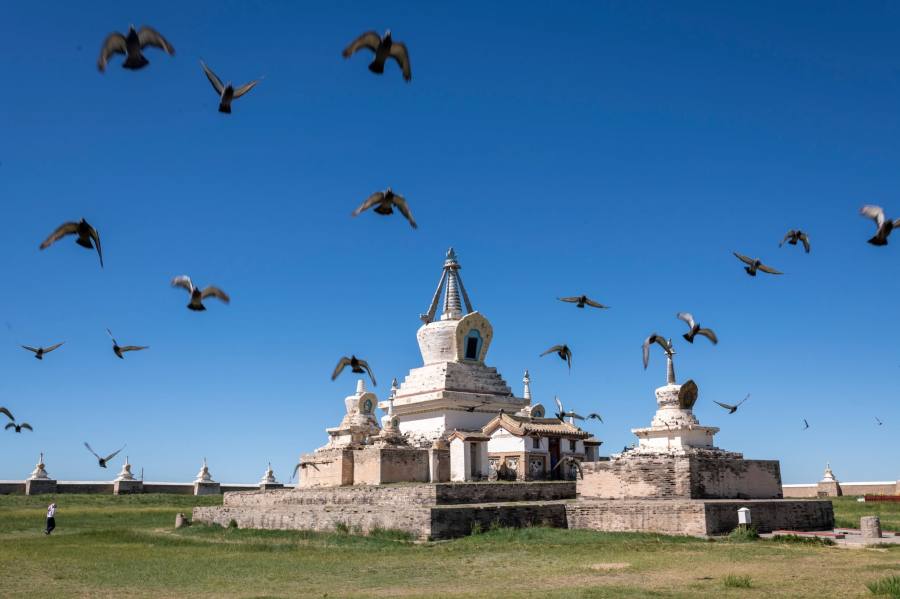
Ulaanbaatar, August 26, 2026 /MONTSAME/. As we traveled toward Erdene Zuu Monastery, 360 kilometers from Ulaanbaatar, in the old Mongol Empire capital of Kharkhorum in Uvurkhangai, many thoughts stirred in my mind.
Built in 1585, the monastery has literally stood the test of time. It has been dismantled more than once over the centuries, and in 1939 Choibalsan Khorloo, the leader of communist Mongolia, ordered its demolition. Only a few parts were left standing. Its recovery came in 1990, when Buddhist monks salvaged whatever they could find to rebuild it, even using bricks and stones from the old palace buildings of the Mongol Empire.
But now Erdene Zuu faces another kind of destruction: its buildings are weathering and aging rapidly under years of sun, wind, snow, and rain, under climate change.
A Priceless Sanctuary
 “For us Erdene Zuu is a sacred
sanctuary; for cultural scholars, it is a great world heritage site,” says
Sodnomdorj Ts., the monastery’s lovon (senior) lama, who trained here as a
novice and now oversees its operations.
Several successive Mongolian states established their capitals here, and the site has long served as a center of statehood, religion, and culture for the people. It is a source of pride that its ancient sacred objects and relics have been preserved so well to the present day. Yet Mongolia’s four seasons and its extreme climate have inevitably left their mark on the monastery’s treasures over time. It is as if our ancestors understood centuries ago that the old method, painting Buddhist images with natural earth-based pigments, was gentler on the natural world.
The lovon lama noted that more recent paints and materials do not last and stressed the need to restore this historic monument using traditional technology.
The Challenge Facing the Museum
 Designated a museum by government
resolution in 1965, the Erdene Zuu Museum holds more than 7,000 artifacts and
has drawn an average of over 70,000 visitors a year over the past five years—more than 40 percent of them foreign tourists, according to its director,
Tumurbaatar N. Since 1990, religious life has revived alongside the museum,
with 20 monks conducting daily prayers.
Its greatest problem is money. "The grounds run to 20 hectares, so wear and erosion are constant, and restoration is always needed. No major financing has come in for several years," Tumurbaatar said.
A shortage of specialists is just as serious. The experts trained in the socialist era have retired, and no new ones are coming up to replace them. Restoration, he added, is left not to qualified specialists but to licensed construction companies, a problem he has raised with the Ministry of Culture many times.
A Lack of Baseline Research
Since 2023, the restorer Angaragsuren O., who earned a doctorate in conservation in Japan, has worked at Erdene Zuu and Shankh Monastery, studying the pigments at Shankh, said Gombojav N., manager of the Orkhon Valley Cultural Landscape World Heritage Site's Protection Administration. Yet the administration has never carried out restoration of its own; its work is limited to monitoring and physical protection, such as fencing.
 Angaragsuren sees a deeper problem.
"The work is done mostly from the angle of an old building, making it
new, making it pretty," he said. "Research into a building's
historical and cultural value is sorely lacking. Measured against the principle
of protecting the authenticity and integrity of heritage, our field is short on
research."
Erdene Zuu's history makes that gap especially costly. The monastery was raised on the site of the Khan's palace at Kharkhorum, using stone and brick from the ruined imperial capital, material still embedded in its walls today. Bricks stamped with the seal of Kharkhorum turned up in the walls of the main Zuu temple of 1586, and stelae bearing Mongol Empire inscriptions have been found in its foundations, terraces, and railings. The Golden Stupa, built in 1799, still stands in its original form, having survived even the political purges.
That stupa was raised for the 25th birthday of the Fourth Bogd Javzundamba, consecrated by the second reincarnation of the Chin Sujigt Nomun Khan and built under Erdene Zuu's reincarnate lama Luvsandagvadarjaa. Because it is a consecrated monument, Angaragsuren argued, restoration must not mean dismantling or renewal. Thorough research should first establish what is causing the surface damage and cracking, and a plan should follow from discussion among researchers across disciplines.
Japan and South Korea show what that looks like. In Japan, altering a nationally protected "important cultural property" is tightly restricted, with years of study preceding any change; the research to restore the fire-damaged murals of Horyu-ji Temple, burned in 1949, is still going on. A team drawn from provincial government, the cultural agency, research institutes, and universities works for at least three years, with the state, local government, and owners sharing the cost. When Seoul's Namdaemun gate burned in 2008, the state led the restoration, identifying the original materials and techniques and rebuilding with exactly those.
Mongolia registers heritage sites on the UNESCO World Heritage List one after another, Angaragsuren noted, but what happens to them afterward remains unclear. Of the 20 monuments listed in the Orkhon Valley, Erdene Zuu and Shankh West Monastery among them, none has a restoration plan, the research is thin, and the policy is undefined.
The Climate Dew Point and the Dead End of No Funding
 Oyuntulga M., who heads the
Conservation and Technology Research Department at the National Center for
Cultural Heritage, explained how climate change works on exposed stone and
clay. In spring, snow and ice melt as the sun rises and freeze again by evening.
With each cycle, moisture condensed inside the structure seeps into its gaps
and expands as it freezes, splitting the material apart — the effect of the
dew-point temperature.
"Compared with developed countries, we lack experience," Oyuntulga said, though the center has been working through international partnerships to bring its temperature and humidity research closer to global standards. The stakes are measurable: nine years of observation with Japanese partners at the Khar Balgas stupa found that weather had worn away 1 to 3 percent of the monument and lowered its height by 10 centimeters.
No detailed materials research has yet been done for the Golden Stupa restoration, she said. The absence of any research budget is the sector's central obstacle, every attempt to study a problem, she explained, hits the same "dead end" for lack of money.
Writing the Golden Stupa's History Together With the United States
Erdene Zuu's Golden Stupa is to be restored with US funding, and US Ambassador Richard L. Buangan attended the project's launch.
The lovon lama said the monastery's foremost concern in the work would be the sacred objects and consecrated scriptures inside the stupa, which it will handle with the greatest care. Most have survived with little damage, their original blessings intact, and the monastery will advise on which texts should be placed within. On the building itself it has no say: as state property, the stupa must be treated by specialists as a cultural structure.
Erdene Zuu was chosen as one of 25 sites worldwide for urgent protection under the World Monuments Watch program of the World Monuments Fund, said Odgerel O., Executive Director of the Arts Council of Mongolia. "Climate and environmental change are putting historical and cultural monuments at risk," she said, pointing to the Choijin Lama Temple Museum, earlier named to the same list and successfully restored, as proof that Mongolia has done this before.
The project's details will firm up in September, she added. A condition survey this August will establish the damage, the materials needed, and where to source them. The overall budget has been approved, though the financing under the agreement has not yet fully arrived.
A Brief Conclusion
The Golden Stupa restoration, beginning with support from the United States and the World Monuments Fund, is expected to become a model for advancing conservation science in Mongolia. Yet specialists speak with one voice: the essentials, financing, experienced specialists, traditional materials and techniques, and detailed damage research are all missing.
Climate change, and the sun, wind, snow, and rain, will not stop. To hand treasures like Erdene Zuu on to future generations, Mongolia needs a scientific, research-driven approach to protecting them. The restoration now getting underway ought to point the way.
This report was prepared with the support of the “Climate, Geoparks, and Heritage Journalism Program,” implemented by the Press Institute with the support of the UNESCO East Asia Regional Office, within the framework of the 17th session of the Conference of the Parties to the UN Convention to Combat Desertification (COP17).

The Golden Stupa 2026.08.10
 "Erdene
Zuu" Monastery, a historical and cultural heritage site that attracts
foreign tourists, 2026.08.10

The Sacred Golden Stupa, 2026.08.10

The Exterior of Erdene Zuu Monastery, 2026.08.11
By Dagiimaa Bat-Erdene and Misheel Chinzorig
Photo by Munkh-Od Ganzorig