Loading…

MONTSAME
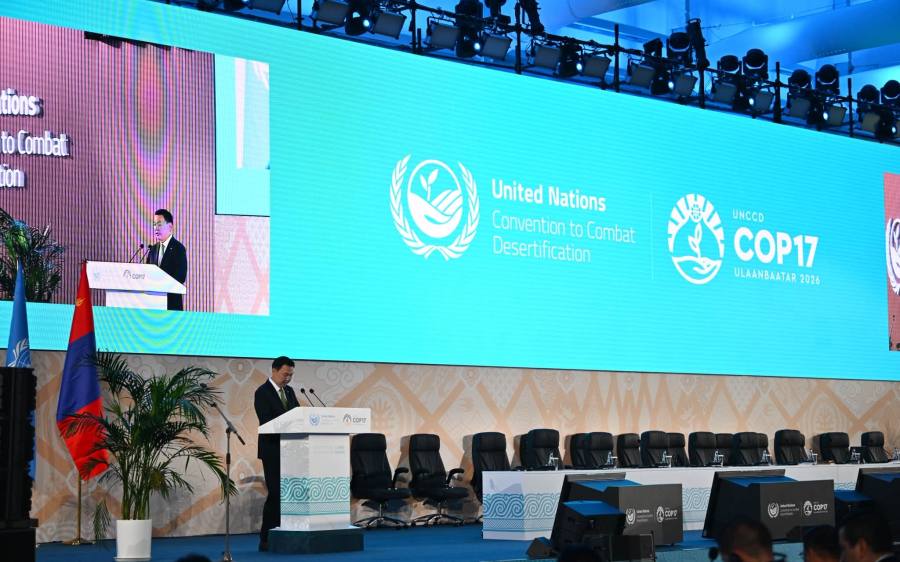
Ulaanbaatar, August 17, 2026 /MONTSAME/. The 17th Session of the Conference of the Parties to the UN Convention to Combat Desertification (UNCCD COP17) opened in Ulaanbaatar on August 17. Mongolian Prime Minister Uchral Nyam-Osor delivered the opening address.
The Prime Minister noted that desertification, land degradation and drought are global challenges closely linked to food and water security, livelihoods, poverty, health, migration, economic development, peace and security. He stressed that COP17 should focus not on repeating previous commitments, but on accelerating implementation and turning commitments into measurable results.
He highlighted Mongolia’s efforts to combat land degradation, including its national land degradation neutrality targets, sustainable rangeland management and the “Billion Trees” national campaign aimed at restoring ecosystems and protecting soil, water and biodiversity.
The Prime Minister also emphasized Mongolia’s long-standing nomadic pastoral traditions and knowledge as a contribution to global efforts on sustainable rangeland management. The UN’s designation of 2026 as the International Year of Rangelands and Pastoralists, initiated by Mongolia, provides an opportunity to raise the importance of rangelands and pastoralists on the global policy agenda.

He said Mongolia is also pursuing a green transition by expanding renewable energy, promoting electric vehicles and developing initiatives such as the “Sunny Mongolian Herder” program, which aims to link herder livelihoods, sustainable pasture management, livestock health, product quality, market access and export competitiveness.
Mongolia is further introducing artificial intelligence, remote sensing, geographic information systems and satellite technologies for land monitoring and natural resource management. Another important initiative is to establish a nationwide network of “Smart Green Schools” and provide future generations with education on sustainable development in environmentally friendly facilities and infrastructure.
Furthermore, Mongolia aims to establish a legal framework for developing “green data centers” based on the characteristics of ecosystems in the cool steppe region, contributing to global innovation and technological development. If we succeed in this, there will be no need to choose between environmental protection and people’s livelihoods. Instead, we can create a new development model in which protecting nature increases income, while higher incomes create greater incentives to protect nature—where the two mutually reinforce each other.
The Prime Minister called for COP17 to deliver a shift “from talk to action, from goals to implementation, and from commitments to measurable results.”
Mongolia proposed six areas for concrete progress: treating land, climate and biodiversity as interconnected issues; increasing investment in land restoration, bringing cooperation among government, international financial organizations and private sector into new level; making drought resilience a core development priority; placing rangelands, herders and local communities at the center of global land management policies; turning science, technology and innovation into practical solutions and investment; and creating conditions to translate commitments into measurable outcomes.
He also called for new partnerships among development partners, international financial institutions, the private sector and governments to overcome barriers related to financing, technology, capacity and regulation.
As part of preparations for COP17, Mongolia’s Office of the President established the National Green Lab, a public-private partnership platform designed to prepare green projects focused on protecting, sustainably managing and restoring rangeland ecosystems for investment and connect them with international financing.
The Prime Minister invited delegates and partner organizations to explore these projects and support Mongolia’s green initiatives. He said Mongolia, as the host and president of the first of this year’s three Rio Conventions’ Conferences of the Parties, aims to strengthen policy coordination and cooperation with the presidencies of the other two conventions and make COP17 a platform for solutions.
He reaffirmed Mongolia’s commitment to open, transparent and inclusive dialogue based on consensus and respect for diverse views.
The Prime Minister expressed hope that COP17, being held on Mongolia’s vast steppe, would become a historic turning point, with the international community recognizing land restoration not merely as an environmental objective, but as a foundation for human development, livelihoods, food security, peace and shared prosperity.