Loading…
Loading…

MONTSAME
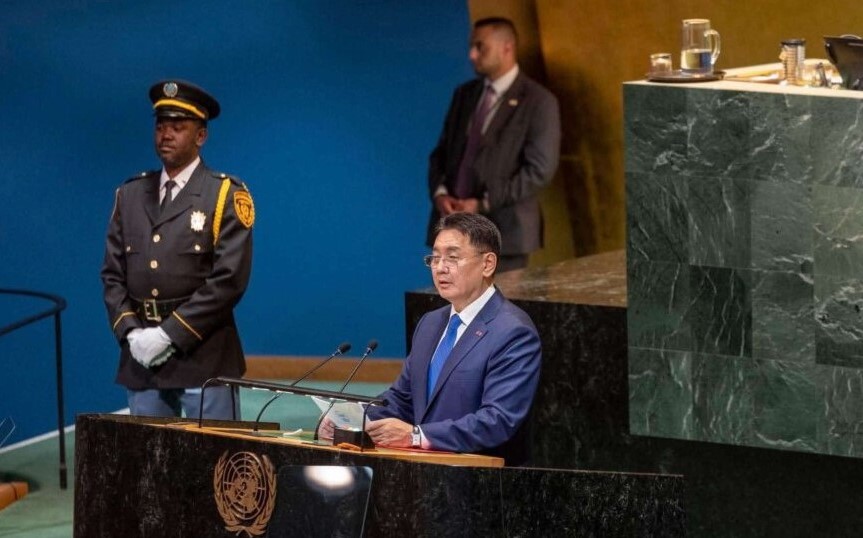
Ulaanbaatar, September 23, 2026 /MONTSAME/. President of Mongolia Khurelsukh Ukhnaa addressed the General Debate of the 81st United Nations General Assembly on September 23, 2026.
In his address, the President emphasized the need to dedicate sincere efforts to strengthening the United Nations, foster international relations based on a multilateral principle that respects pluralism, and pay greater attention to climate action, peacekeeping operations, education, healthcare, food security, women and children, and the development of Landlocked Developing Countries (LLDCs). He also officially announced Mongolia’s candidature for a non-permanent seat on the UN Security Council for the term 2048–2049.
"Mr. President of the General Assembly,
Mr. Secretary-General,
Distinguished delegates,
Ladies and gentlemen,
First and foremost, I extend my heartfelt congratulations to you, Mr. Khalilur Rahman, on assuming the highly responsible role of President of the 81st Session of the United Nations General Assembly, and I wish you great success in the session's proceedings.
This General Assembly session unfolds on the eve of the 65th anniversary of Mongolia's full membership in the UN. Back in 1961, Mongolia proudly hoisted its flag with the golden Soyombo at the UN rostrum, becoming the 101st sovereign member state of this great institution, a guarantor of global peace and security and a beacon of hope for nations worldwide.
We welcome the theme of the 81st Session of the UN General Assembly: 'Restoring Trust, Managing Transformation: A United Nations that Delivers for All,' a center for trust, mutual respect, and cooperation among the peoples of the world.
As a Mongol proverb goes, 'If you endeavour, the fate will favour you.' The UN is an organization formed by the faith of every member state and strengthened by their joint efforts. Therefore, we, the member states, must approach UN matters with utmost sincerity, not merely expecting support and assistance, but deeply realizing our own duties and responsibilities, and dedicating ourselves to strengthening the UN.
The hope, dedication, duty, and participation of every member state will fortify the UN. In turn, a stronger UN will more effectively ensure global peace, security, and sustainable development, creating conditions where every member state can reap the benefits.
At a time when the lightning of conflicts strikes the world, walls of distrust rise higher, and abysses of misunderstanding deepen, it is crucial to develop international relations not toward unipolar division, but rather on multipolar principles that respect pluralism rooted in each country's history, civilization, fundamental national interests, and development path.
Eight centuries ago, our ancestors established the 'Pax Mongolica' across the globe, showing that nations must mutually recognize one another's values and that civilizations and religions can coexist. Based on this spirit of Pax Mongolica, let us strengthen multilateral cooperation through multipolar principles, restore our hope through shared responsibility, renew our UN with a unified purpose, and build a better, peaceful world through our joint efforts.
Mr. President of the General Assembly,
Although humanity has reached a high level of development, currently there are over 90 armed conflicts globally, of which more than 30 have taken on international dimensions. This indicates that global peace and security remain volatile and that geopolitical and geostrategic competition is sharply intensifying. Consequently, global economic supply chains are disrupted, the prices of energy, fuel, raw materials, and food are rising, and the economies of various nations are facing severe challenges. This is weakening the international order established since World War II, altering universally recognized norms of international law, and destabilizing multilateral relations and cooperation.
Mongolia concurs with UN Secretary-General António Guterres, who noted in this year's report on the work of the Organization that in today's world filled with turmoil, division, and uncertainty, the UN is needed and more relevant than ever. We highlight that tangible progress is being made under the 'UN-80' reform agenda he initiated to adapt the UN to contemporary challenges and make it more effective, and Mongolia reaffirms its active support for this program.
How effective the UN will be, how decisive its actions will be, and how well nations will unite their efforts depend entirely on us, the member states. Mongolia remains confident that the newly elected Secretary-General will steadfastly defend the UN's purposes, principles, and international law, equally represent the voices and positions of member states, restore trust, and lead necessary reforms.
Mongolia believes that reform of the Security Council must be at the core of UN reforms, and therefore adheres to the principled position of increasing the number of permanent and non-permanent members of the Security Council, properly ensuring the representation of developing nations, and making its operations more open and transparent. Mongolia is one of the 58 states that have never served as a non-permanent member of the UN Security Council.
Our country strives to actively participate in the Security Council's activities and contribute to finding collective solutions to the issues and challenges facing the international community. Thus, Mongolia officially announces its candidacy for a non-permanent seat on the UN Security Council for the 2048-2049 term.
Mr. President of the General Assembly,
Over the 65 years since Mongolia became a full-fledged member of the UN, the UN and its system organizations have made invaluable contributions to our country's development and maintained highly fruitful cooperation. On behalf of the Mongol people, I express my sincere gratitude. Mongolia has honorably contributed to efforts upholding the UN's core principles: strengthening international peace and security, advancing socio-economic development, and protecting human rights.
For instance, in pursuing our foreign policy goal of ensuring Mongolia's security through political and diplomatic means, more than 30 years have passed since our country declared its territory a 'Nuclear-Weapon-Free Zone.' During this time, we have consistently implemented policies and activities aimed at institutionalizing this status legally, successfully having the resolution on 'Mongolia's international security and nuclear-weapon-free status' adopted by the UN General Assembly biennially since 1998.
Furthermore, since 2002, Mongolia has dispatched over 23,000 military and police personnel to global hotspots, actively participating in UN peacekeeping and other international operations, and providing tangible support to the cause of maintaining global peace and security. Even today, our peacekeepers are serving in Haiti, participating in the multinational military mission to combat gang violence.
Our nation has actively worked to implement UN Security Council Resolution 1325 on 'Women, Peace, and Security,' becoming one of the few countries to reach 15% representation of female military personnel in UN peacekeeping operations. Over the 20 years since deploying our first female peacekeeper to the mission in Western Sahara in 2006, the courage, endurance, and wisdom of Mongol women have made a valuable contribution to the global cause of peace.
Therefore, our country plans to host the Second International Conference of Women Peacekeepers in Ulaanbaatar in 2027. Additionally, it is a pleasure to note that Mongolia has been a leader within the UN in defending the interests of Landlocked Developing Countries (LLDCs), raising awareness of their special needs, requirements, and vulnerabilities to the international community, and working jointly to protect their interests and amplify their voices globally.
In this context, our country has spearheaded numerous initiatives, such as the Group of LLDCs at the UN and the International Think Tank for LLDCs in Ulaanbaatar. To translate the 'Awaza Programme of Action' into reality, it is critical for LLDCs to integrate this program into their national development strategies while maximizing all available resources to intensify regional integration and cooperation. We also urge the international community, banking and financial institutions, and development partners to collaborate with and provide concrete support to landlocked developing countries.
Mr. President of the General Assembly,
As the deadline for the 2030 Agenda for Sustainable Development rapidly approaches, a 2026 UN report indicates that only 36% of the goals are adequately on track, while 15% have regressed. According to the Stockholm International Peace Research Institute, it is deeply regrettable that global military expenditures have hit an all-time high, measured at USD 2.9 trillion.
It is high time for the global community to soberly reflect on the immense positive impact this vast amount of funding could have had on human development and progress had it been directed toward pressing challenges such as global warming, climate change, education, healthcare, food security, and the development of women and children.
According to the UN 'Sustainable Development Report 2026,' Mongolia's implementation of the SDGs stands at 68.8%, a tangible result and success of our efforts in recent years. As a country truly experiencing the negative impacts of climate change, Mongolia continues to contribute to global collective efforts to protect nature. To this end, we are successfully implementing national movements and programs such as the 'Billions of Trees,' 'Food Revolution,' 'White Gold,' 'Blue Gold,' and 'Healthy Mongolian' to promote land rehabilitation, increase forest cover, protect soil, water, and pastures, ensure food security and safety, and support sustainable rural development.
The 'Billions of Trees' national movement is not merely about planting and growing trees, but a comprehensive initiative to combat desertification and land degradation, expand land rehabilitation, increase forest cover, protect soil fertility, water resources, and biodiversity, mitigate the adverse effects of climate change, improve food supply, and create jobs. Additionally, within the framework of the UN General Assembly resolution initiated by Mongolia to designate 2026 as the International Year of Rangelands and Pastoralists, we now have an opportunity to draw global attention to the value of rangeland ecosystems, pastoralists' livelihoods, food systems, biodiversity, and nomadic cultural heritage.
In this vein, our country, with its ancient historical tradition of nomadic pastoralism, successfully hosted the Global Forum of Pastoralists. Over 400 pastoralists from 57 countries attended this forum to share their views, discuss challenges and solutions, and adopt the Ulaanbaatar Declaration. Furthermore, we successfully hosted the 17th Conference of the Parties (COP17) to the UN Convention to Combat Desertification under the theme 'Restoring Land, Restoring Hope' last month.
Restoring the pristine state of Mother Nature and ensuring that future generations live confidently and contentedly in a healthy environment must be humanity's sacred duty. Mother Nature and healthy soil are the guarantors of human existence and the foundation of food and water resources, livelihoods, and sustainable development.
If the soil is healthy, the food is healthy; if the food is healthy, the people are healthy. Therefore, the issues of desertification, land degradation, and drought should not be viewed merely as environmental concerns, but must be addressed holistically, linking them to food supply and safety, water resources, human livelihoods, sustainable development, and global peace and security.
As the President of COP17, the 'Steppe Action Agenda' initiated by Mongolia rests on three interconnected pillars: the 'Rangelands Flagship Initiative,' the 'Integrated Water and Land Management Initiative,' and the 'Sustainable Infrastructure with Nature-Based Solutions Initiative.' In particular, we view the 'Rangelands Flagship Initiative' as a major movement opening a new chapter in the history of global rangeland conservation.
This initiative is distinguished by its effort to demonstrate to the world that protecting, sustainably utilizing, and rehabilitating rangelands is a strategic imperative for building climate resilience, ensuring food security, and maintaining ecological balance.
The nomadic lifestyle inherited by the Mongols over millennia is an integrated system of mentality, attitudes, and wisdom centered on living in harmony with Mother Nature and keeping it pristine. Today, we Mongols aim to share this cultural heritage and our traditional knowledge and experience of living in harmony with the earth with the global community, thereby contributing to enhancing climate adaptation and resilience.
Mr. President of the General Assembly,
Mongolia has consistently upheld the stance of resolving any conflicts through diplomatic means and multilateral dialogue, maintaining traditionally good relations with regional countries. Leveraging this unique advantage, we hosted the 11th 'Ulaanbaatar Dialogue' on Northeast Asian Security this year.
The 'Ulaanbaatar Dialogue,' aimed at strengthening trust in Northeast Asia, has evolved into a unique platform that facilitates multilateral discussions among official representatives and scholars on traditional topics like politics and disarmament, as well as energy, infrastructure networks, green development, and humanitarian cooperation.
In its active role as a sovereign UN member, Mongolia has contributed to fostering international cooperation in advancing gender equality, strengthening women's political participation and leadership, and increasing their representation at decision-making levels.
In recent years, it has become a tradition for us to host international women's events in our country. For instance, Ulaanbaatar hosted the International Conference of Women Peacekeepers in 2022, the Female Foreign Ministers' Meeting in 2023, the World Women's Forum in cooperation with the UN in 2024, and the World Women Entrepreneurs' Forum in 2025.
We are confident that the Forum of Women Parliamentarians, to be held in Ulaanbaatar on October 12-13, will make a due contribution to strengthening women's political leadership and inter-parliamentary cooperation, thereby accelerating progress on gender equality and the realization of the Sustainable Development Goals.
I invite you all to participate in this forum at a high level and with a broad delegation. Mongolia will always serve as a solid bridge of partnership, cooperation, and solidarity in enhancing the social and political leadership and participation of women at all levels.
Mr. President of the General Assembly,
Within the international community, Mongolia has launched and steadfastly supported numerous initiatives aimed at disseminating cultural heritage, traditional knowledge, and common human values. For example, recognizing the valuable contribution of horses to the history, civilization, and socio-economic development of peoples around the world, we initiated and secured the adoption of the UN General Assembly resolution declaring 'World Horse Day' in 2025.
Furthermore, the historical and cultural value of the aristocratic burial complex of the Hunnu, the first Mongol state, gained international recognition and was inscribed on the UNESCO World Heritage List last July. I am also pleased to note that Mongolia is serving its first-ever term as a member of the UNESCO World Heritage Committee for 2026-2029.
This year marks the 820th anniversary of the founding of the Great Mongol Empire by Chinggis Khaan, the man of the millennium and the Khaan of Khaans. The UN General Assembly Resolution, adopted on the occasion of the 800th anniversary of the Great Mongol Empire, highly commended the contribution of the Mongols to world history. It noted that the Great Mongol Empire 'promoted the exchange of cultures and traditions between East and West, served as a bridge linking civilizations, established major administrative, cultural, religious, and trade centers through an extensive trade network, and played a crucial role in developing relations and dialogues among civilizations of all forms.'
This illustrates that it possessed progressive ideals that could serve as the foundation for modern collective efforts to maintain peace and stability. For example, in his 1305 official letter to King Philip of France, Ilkhaan Ulziit eloquently highlighted the benefits of harmonious relations among nations with the wise words: 'Now, what could be better than true harmony?' As the Mongolist Władysław Kotwicz stated in his work.
History is the foundation for reflecting on the past, building the present, and shaping the future; it is the memory of statehood. International scholars advise that studying how Chinggis Khaan and his successors established the 'Pax Mongolica' and examining their history of foreign policy and diplomacy yields many positive paradigms and valuable lessons.
Therefore, from this esteemed rostrum of the United Nations, we, the Mongols and inheritors of the legacy of the Great Mongol Empire, call upon the international community to recognize that, through cooperation among nations, it is possible to build global peace in the spirit of the 'Pax Mongolica', which eight centuries ago contributed to peaceful coexistence and human progress.
The role and engagement of the United Nations in strengthening mutual understanding, trust and respect among nations, promoting peace, security and prosperity, and advancing shared progress are more important than ever.
Let us work together to make the United Nations, as a guarantor of international peace and security and a beacon of hope for humanity, a stronger and more influential institution capable of advancing the cause of 'Global Peace'.
May the Eternal Blue Sky forever bless humanity, and may there be peace throughout the world.
Thank you for your attention."