Loading…
Loading…

MONTSAME
Ulaanbaatar, August 26, 2026 /MONTSAME/ On the ninth day of COP17, August 25, marked as Water Day, a forum on the sidelines of the conference argued for valuing nature not by what can be extracted from it, but for its worth as it stands. At the center was Gross Ecosystem Product (GEP), a way of counting the contributions of natural capital such as forests, oceans, and clean air — an approach meant to help those who think in financial terms see the value of nature itself. How successful it can be remains an open question. But as global markets fail to move away from the fossil fuel use that is deepening climate change, the idea may prove a novel one.
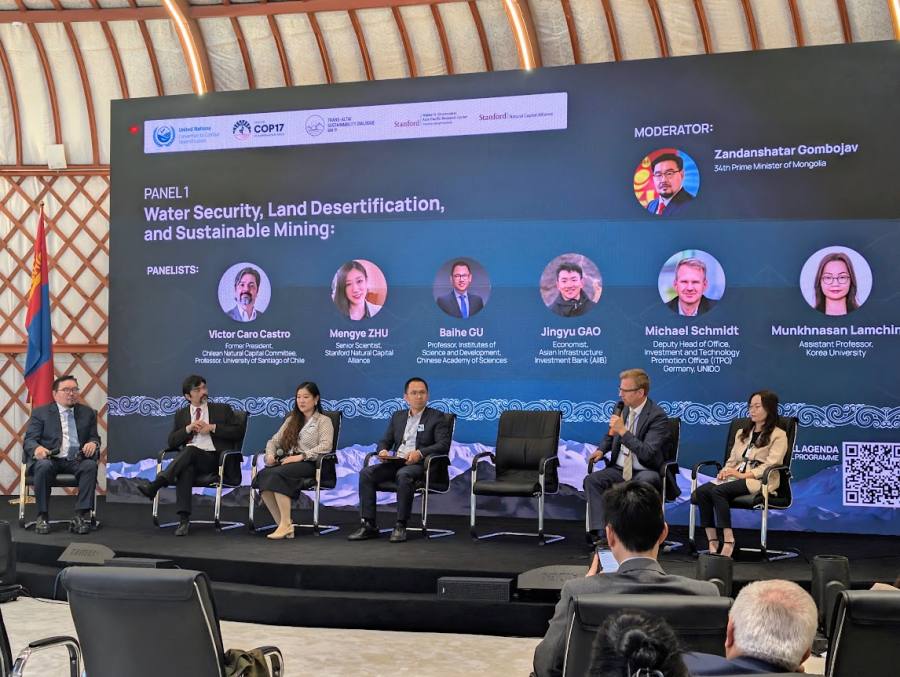
The fifth Trans-Altai Sustainability Dialogue, held under the title "Water Security in Mining Regions: A Natural Capital Approach to Addressing Desertification," was convened alongside Stanford University's Natural Capital Alliance and the Walter H. Shorenstein Asia-Pacific Research Center. It was led and moderated by former Prime Minister Zandanshatar Gombojav, who championed GEP and argued that mining companies must adhere to it and reckon with the true value of water. The dialogue turned on a single question: what is one cubic meter of Mongolian groundwater actually worth?
"I can tell you the exact value of a tonne of our copper," Zandanshatar said. "Yet we remain profoundly blind to the financial value of the very systems that allow those commodities to exist."
Making the invisible visible
Gross Ecosystem Product was the focal point of the dialogue, with Zandanshatar's opening speech and the two keynote addresses all making the case for bringing GEP into policy discussions. Unlike GDP, which most people know as a measure of an economy's output, but which reveals little about the financial security of the wider population, GEP is an accounting approach that assigns a monetary value to the goods and services an ecosystem provides. GEP would account for clean water and healthy soil for carbon storage. The idea is that once nature carries a number, it can enter budgets, investment decisions, and law, rather than being treated as free and, in practice, worthless. A solution to the tragedy of the commons?
Zandanshatar argued that this shift is the missing link in Mongolia's environmental policy. He acknowledged the view, rooted in nomadic culture, that nature is "priceless" and should not be assigned a monetary value. But in the practical arithmetic of budget-making, he countered, "priceless things receive zero structural attention." An empirical number, he said, "is what gives a river a lawyer" — pointing to a national inventory that recorded 887 rivers and streams, 2,096 springs, and 1,166 lakes and ponds drying up, with no account of the economic value lost alongside them.
He called for Mongolia to establish formal Natural Capital Accounts for its ecosystems, citing China's move in January to institutionalize GEP valuation and Chile's national Natural Capital Committee. He also proposed a Trans-Altai Natural Capital Alliance to build a shared methodology for valuing the water, ice reserves, and rangeland of the transboundary Altai range, noting that the glacier of Munkh Khairkhan — the Eternal Mountain — has lost 38 percent of its surface area.
A balance sheet that makes a nation "feel richer"
Keynote speakers took up the same thread. Gim Huay Neo, Managing Director and Chief Representative of the World Economic Forum's China Office, warned that the world faces what the UN has termed "water bankruptcy," with damage to global water systems now affecting roughly three-quarters of the world's population.
"Water is the first manifestation of global warming — too much, too little, too polluted," she said. "And obviously it is the source of life." Neo tied the crisis to the WEF's concept of a "polycrisis," in which climate, water, and land degradation feed on one another to impose consequences far worse than any one of them alone.
The answer, she argued, lies in how societies choose to keep their books. "The recognition of nature as capital should make us feel wealthier, more abundant," Neo said. "By having nature reflected on the balance sheet, we should feel richer."
Victor Caro Castro, former president of Chile's Natural Capital Committee and a professor at the University of Santiago, described how his country has tried to turn that principle into policy. The goal, he said, is "to transform natural wealth into well-being and social capital — better living conditions, stronger capabilities, and greater security for our citizens today and in the future."
He was careful to define what the approach is not. "This approach doesn't seek to put a price on all of nature," Caro said. "It is to make visible what often remains invisible when we make decisions about infrastructure, land use, and public or private investment." Companies, he added, affect nature — "but they also depend on it."
The test case: Oyu Tolgoi
Zandanshatar closed by turning the abstract argument into a concrete confrontation, training the natural-capital lens directly on Oyu Tolgoi, the world-class copper mine in the Gobi operated by Rio Tinto. The mine draws its water from the deep saline reserves of the Gunii Hooloi basin. While hydrogeological studies indicate a thick clay layer isolates that aquifer from surface water, Zandanshatar noted that nomadic herders in the area consistently report their shallow wells drying up. The company, he acknowledged, has installed automated monitoring and financed more than 200 solar-powered smart wells to secure community access — but he dismissed such measures as "a bandage" that does not fix what he called a broken regulatory arithmetic.
Recounting a visit he made as Prime Minister to the State Water Agency on March 21, 2026, just ahead of World Water Day, he said he issued a direct mandate for the agency to collect water pollution payments uniformly from all major heavy industries. "And I explicitly called out Oyu Tolgoi," he said. The agency subsequently calculated that the mine owed MNT 5.1 billion in water pollution fees for 2020 through 2025. Yet for more than fifteen years, he said, not a single tugrug had been paid, with the mine relying on its historical contract and a "zero discharge" design to claim exemption. The retroactive fee, he noted, still has not been fully settled and remains under negotiation as part of ongoing changes to the framework agreement.
"A statutory law left unenforced or caught in gridlock for fifteen years has not been respected," he said. "It has been ignored. And the state allowed it to be ignored."
The root of the problem, he argued, lay not in a single company but in a scientific gap written into the law itself: because the statute charges strictly on measured pollutant load, it demands an exact figure before payment can be sought — and Mongolia lacked the independent, real-time data to produce one. "What a nation cannot measure, it cannot defend," he said.
Looking ahead, he announced a mandate for legislative reform: Mongolia will raise water usage payments for the mining sector on an escalating scale aimed at its largest projects. Current base tariffs for heavy industry, he said, are "profoundly, systematically inadequate," failing to reflect the true depletion cost of ancient desert aquifers replenished at just one millimeter a year while operators draw tens of millions of liters a day.
"Let me say to Rio Tinto and our international partners: efficiency is commendable, but the baseline price of entry into Mongolia's subsurface nature is going up," he said.
Returning to his opening question, Zandanshatar admitted he still did not know the final value of Mongolia's groundwater. "But as we look at the accelerating desertification of our steppes, the vulnerability of our nomadic heritage, and the intensifying demands of our industrial economy, I have stopped believing it is an unanswerable question."
The dialogue also featured research from Stanford's Natural Capital Alliance on water-related natural capital as infrastructure for sustainable mining, and two panels bringing together experts from the Asian Development Bank, the Asian Infrastructure Investment Bank, UNIDO, UNDP, the Chinese Academy of Sciences, and Korea University, among others.