Loading…
Loading…

MONTSAME
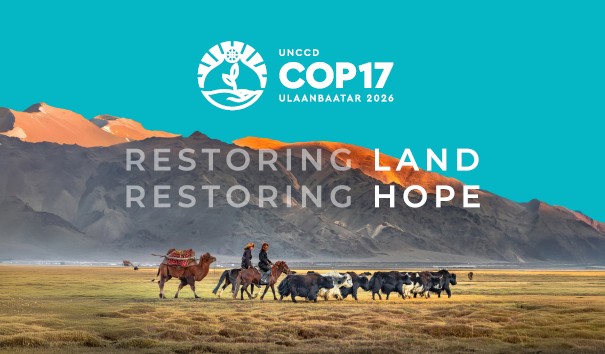
Presentation of the "Steppe Action Agenda" Proposed by Mongolia for the 17th Conference of the Parties (COP17) to the United Nations Convention to Combat Desertification (UNCCD)
Mongolia has unveiled a comprehensive strategic framework known as the "Steppe Action Agenda," targeting the interconnected global threats of land degradation, climate change, and biodiversity loss.
Designed to serve as a primary policy legacy for the 17th Conference of the Parties (COP17) to the United Nations Convention to Combat Desertification (UNCCD), the Steppe Action Agenda establishes an integrated blueprint to advance regional and global sustainability.
At its core, the agenda aims to bridge historically siloed environmental mandates by strengthening synergy and cooperation across the three United Nations Rio Conventions: the UNCCD, the Framework Convention on Climate Change (UNFCCC), and the Convention on Biological Diversity (CBD).
Under the new framework, international commitments, including Land Degradation Neutrality (LDN) targets, Nationally Determined Contributions (NDCs), National Adaptation Plans (NAPs), and National Biodiversity Strategies and Action Plans (NBSAPs), will be harmonized into a unified execution system to streamline implementation and accelerate long-term results.
The framework targets longstanding systemic barriers that have historically slowed environmental progress, including fragmented monitoring data, persistent financing gaps, weak inter-agency coordination, and inconsistent policy alignment. By addressing these bottlenecks, the initiative aims to transform high-level international pledges into bankable, scalable, and measurable long-term projects.
Crucial to its execution strategy is an inclusive partnership network uniting governments, private investors, international development banks, civil society, academic institutions, local communities, indigenous groups, and youth leaders.
Through this collaborative ecosystem, the agenda leverages knowledge-sharing, technology innovation, and targeted capital mobilization to deliver tangible, real-world outcomes in sustainable land use and ecosystem governance.
The "Steppe Action Agenda" will be implemented through three global initiatives aimed at addressing interconnected challenges, including land degradation, biodiversity loss, climate change, water security, sustainable infrastructure, and resilient, sustainable economic development:
The Rangeland Flagship Initiative is a joint effort between Mongolia and the UNCCD Secretariat aimed at supporting actions to protect, sustainably manage, and restore global rangeland ecosystems. This initiative aims to reduce rangeland degradation, conserve biodiversity, enhance climate change adaptation and resilience, improve ecosystem services, and strengthen the participation and leadership of indigenous peoples and local communities.
The Integrated Water and Land Management Initiative is a global initiative developed under Mongolia's leadership in collaboration with international partners, aimed at supporting integrated planning, governance, and investment based on the water-land-ecosystem nexus. This initiative aims to address growing risks arising from water scarcity, land degradation, ecosystem degradation, and climate change through science-based and coherent approaches.
The Nature-Based Solutions for Sustainable Infrastructure Initiative focuses on systematically incorporating Nature-based Solutions (NbS) into infrastructure planning, financing, and construction to foster an environmentally friendly, climate-resilient, and resource-efficient development model.
These three global initiatives will serve as the primary pillars for implementing the "Steppe Action Agenda." By integrating sustainable rangeland management, integrated water and land governance, and nature-based solutions, the "Steppe Action Agenda" will foster a cross-sectoral, holistic approach that generates multi-faceted environmental, social, and economic benefits. Furthermore, it will accelerate the achievement of the Sustainable Development Goals (SDGs) by strengthening partnerships, developing innovative financing mechanisms, supporting science-based decision-making, and ensuring synergy in implementation. It will also support the realization of Mongolia's long-term development policy, "Vision-2050," and its green development targets.
In doing so, it holds significant importance for delivering tangible results at national, regional, and global levels in land restoration, biodiversity conservation, climate adaptation capacity, food and water security, and sustainable development, thereby advancing the long-term objectives of the three Rio Conventions.

Rangeland Flagship Initiative
The "Rangeland Flagship Initiative" is an international, multi-stakeholder partnership initiative led jointly by Mongolia and the UNCCD Secretariat. It focuses on catalyzing investment and cooperation for the protection, sustainable management, and restoration of rangeland ecosystems, while supporting the achievement of Land Degradation Neutrality (LDN) targets.
The initiative is scheduled to be officially launched during the 17th Conference of the Parties (COP17) to the UNCCD, hosted by Mongolia from August 17 to 28, 2026, within the framework of the International Year of Rangelands and Pastoralists (IYRP).
At the center of the agenda is the Rangeland Flagship Initiative, designed to unite global efforts tackling desertification, biodiversity loss, climate change, poverty, and food insecurity. Recognizing that rangelands are critical for carbon sequestration, water regulation, and the livelihoods of millions, the initiative applies an integrated approach to deliver simultaneous environmental, social, and economic benefits.
In alignment with the Kunming-Montreal Global Biodiversity Framework, the initiative will support expanding protected rangeland areas and formalizing recognized conservation zones, known as Other Effective Area-Based Conservation Measures (OECMs).
The strategy also incorporates key mandates from COP27 of the UNFCCC, reinforcing climate resilience through sustainable land management, optimized grazing, and improved livestock practices. By lowering greenhouse gas emissions and expanding adaptive capacity, these measures directly support nations in meeting their climate targets under Nationally Determined Contributions (NDCs).
The Rangeland Flagship Initiative will support the implementation of key decisions from UNCCD COP16, including Decision UNCCD COP16/L.15 on Rangelands and Pastoralists. The initiative aims to translate these decisions into tangible global action and scale up investments directed at protecting, sustainably using, and restoring rangelands.
The Rangeland Flagship Initiative consists of three components:
Component 1: Knowledge and Policy Frameworks
To ensure sustainable rangeland management, knowledge products, including Land Degradation Neutrality (LDN) principles, rangeland sustainability standards, rangeland health assessment methodologies, and cost-benefit analyses of rangeland restoration, will be developed to enable their integration into policy, planning, and investment decision-making.
Component 2: Investment Portfolio Development
Support will be provided for the development and implementation of a portfolio of rangeland restoration investment projects covering issues such as land degradation, drought resilience, biodiversity loss, carbon sequestration, climate change mitigation and adaptation capacity, cultural heritage protection, food security, and livestock value chains.
Component 3: Global Coalition and Regional Coordination
A global coalition will be established to advocate for rangeland policies and investments internationally, as well as to expand partnerships and cooperation. The activities of this coalition will be coordinated through the Eurasian Center to Support Regional Cooperation and Implementation in Sustainable Management, Conservation, and Restoration of Arid and Semi-Arid Lands.
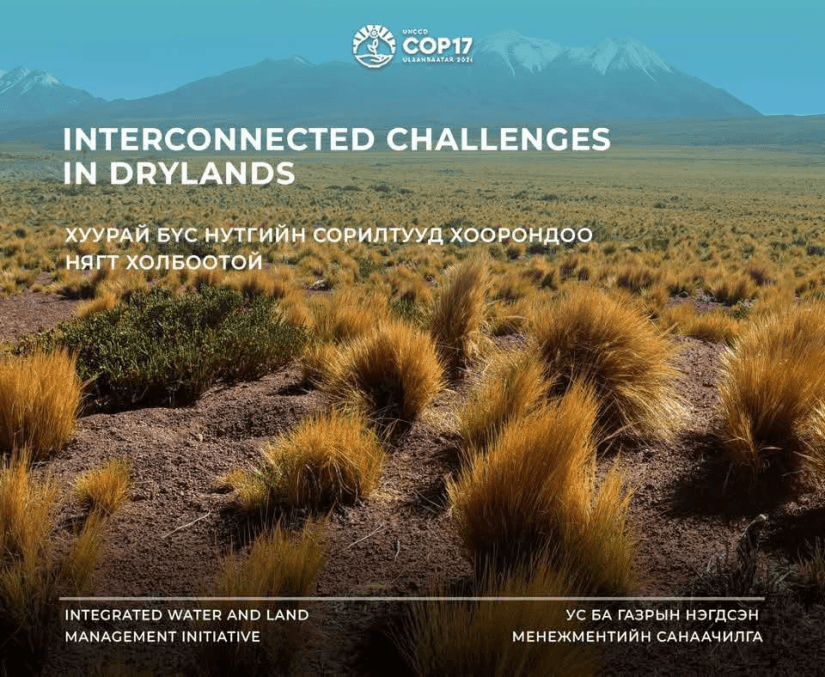
Integrated Water and Land Management Initiative
The Integrated Water and Land Management Initiative is a global initiative implemented under the leadership of Mongolia in partnership with international organizations and development partners. The initiative takes a holistic view of the water-land-ecosystem nexus to strengthen environmental sustainability, climate resilience, and sustainable development in dryland regions.
This initiative focuses on addressing interconnected challenges, such as water scarcity, land degradation, drought, biodiversity loss, ecosystem degradation, and climate change, through an integrated approach. By treating water, land, and ecosystem management not in isolation but as an interdependent system, it will enhance the impact of policy, planning, investment, and implementation, thereby contributing to the sustainable use of natural resources and strengthening ecosystem resilience.
Additionally, while strengthening international cooperation, knowledge systems, monitoring frameworks, science-based decision-making, and investments, it will disseminate circular water management approaches that promote water efficiency, reuse, recycling, and resource circulation. In doing so, it will contribute to enhancing water security, drought resilience, ecosystem health, and sustainable development.
This initiative will contribute to the implementation of UN-Water, the UN-Water System-wide Strategy for Water and Sanitation, and UNCCD COP16 decisions regarding drought resilience. It will also support the achievement of targets under the Global Biodiversity Framework for protecting and restoring aquatic ecosystems, as well as resolutions and decisions of the United Nations Environment Assembly (UNEA) on ecosystem restoration, aquatic ecosystems, and Nature-based Solutions.
It also aims to strengthen synergies among international targets and actions on water, climate change, biodiversity, and land restoration. The Integrated Water and Land Management Initiative consists of three main components:
Component 1: Knowledge, Governance, and Partnership
Knowledge and information systems, monitoring networks, data-sharing platforms, and early warning mechanisms will be developed to support integrated water, land, and ecosystem management. Furthermore, water governance, policy dialogue, international cooperation, and partnerships will be strengthened to expand collaboration on transboundary water resources and shared environmental challenges.
Component 2: Piloting, Implementation, and Scaling Up
Support will be provided for piloting, localizing, and scaling up solutions based on integrated water, land, and ecosystem management. Key areas include river basin restoration, circular water management, Nature-based Solutions, drought risk reduction measures, and integrated landscape management.
Component 3: Financing and Investment Mobilization
Efforts will focus on attracting public and private investment, strengthening multi-stakeholder collaboration, and developing pipelines of bankable projects. Innovative financing mechanisms and strategic partnerships will also be leveraged to expand the scope and impact of implementation.
The Integrated Water and Land Management Initiative aims to establish integrated water and land management as a foundational condition for sustainable development in dryland regions. By adopting a coherent approach aligned across water, land, and ecosystem management, alongside circular water management, policy coordination will improve, investment efficiency will rise, and sustainable development outcomes will be strengthened. Ultimately, this will improve water security, restore ecosystem functions, foster productive and resilient landscapes with enhanced drought capacity, and deliver long-term positive impacts on environmental sustainability, resilient economic growth, and human well-being.
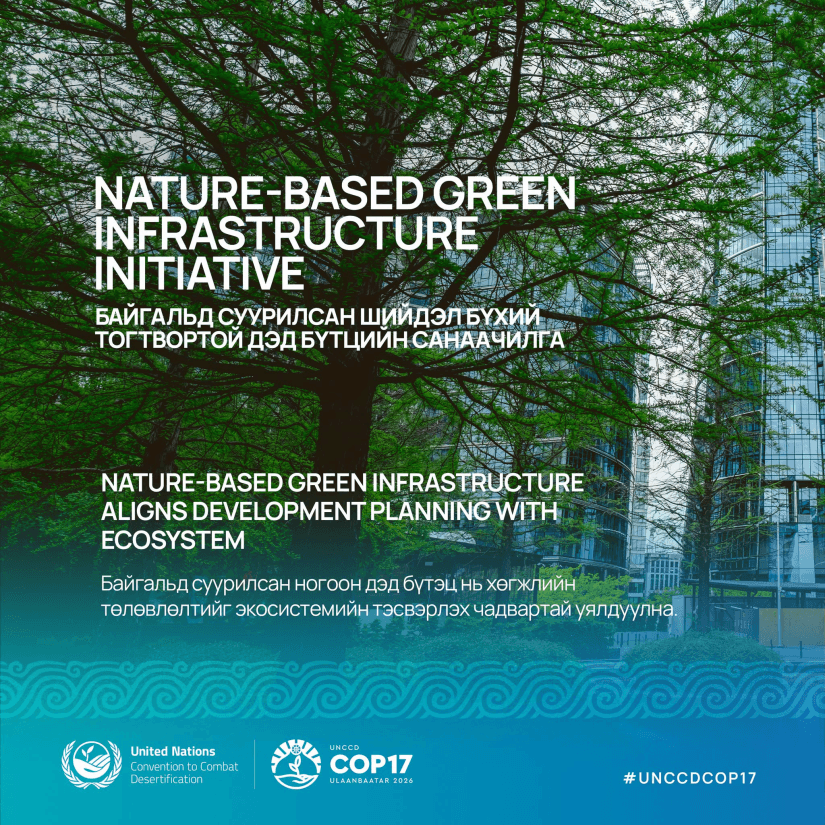
Nature-Based Solutions for Sustainable Infrastructure
The Nature-Based Solutions for Sustainable Infrastructure Initiative is an international initiative led by Mongolia in collaboration with international organizations and partners, aimed at developing infrastructure systems that are environmentally friendly, climate-resilient, and tailored to land use and ecosystem characteristics. Viewing natural resources and ecosystem services as a crucial foundation for infrastructure development, this initiative aims to integrate Nature-based Solutions into infrastructure planning and investment policy to mitigate risks, enhance climate resilience, and promote sustainable development.
The Nature-Based Solutions for Sustainable Infrastructure Initiative encompasses an integrated approach combining "hard" infrastructure, such as land, water, energy, transport, urban development, and landscape systems, with "soft" infrastructure, which creates conditions for their effective planning, financing, and management.
A key feature of the initiative is planning powered by artificial intelligence and advanced technology. By utilizing geographic information systems (GIS), remote sensing, digital and predictive modeling, and AI-driven decision-support systems, it will improve eco-friendly, location-tailored infrastructure planning, risk management, and investment decision-making. Harmonizing "green," "blue," and "grey" infrastructure with Nature-based Solutions will enhance resilience against climate and environmental risks, creating opportunities to mobilize public and private investment.
This initiative aligns with UNEA Resolution 5/5 on Nature-based Solutions, Targets 2, 8, 11, 12, and 14 of the Kunming-Montreal Global Biodiversity Framework, UNCCD COP decisions 19/COP.16 and 24/COP.16, as well as the Sharm el-Sheikh Implementation Plan and Decision 1/CMA.5 on the first Global Stocktake under the UNFCCC. Furthermore, it aims to adopt the IUCN Global Standard for Nature-based Solutions to enhance infrastructure quality assurance, accountability, and investor confidence. This will strengthen synergies across the three Rio Conventions and contribute to turning global commitments into actionable, scalable solutions.
The Nature-Based Solutions for Sustainable Infrastructure Initiative consists of three main components:
Component 1: Green AI-Powered Digital Infrastructure and Systems
Development of AI-driven ecological information systems, GIS platforms, environmental monitoring networks, digital and predictive modeling, and decision-support tools to support place-based infrastructure planning, risk management, and investment decision-making.
Component 2: Policy, Planning, and Implementation
Integration of Nature-based Solutions into infrastructure policy, land-use planning, and infrastructure delivery frameworks, scaling up application across water, energy, transport, agriculture, urban development, and landscape restoration sectors.
Component 3: Financing and Investment Mobilization
Increasing public and private investment through innovative financing mechanisms, blended finance models, bankable project pipelines, and strategic partnerships to support the widespread adoption and implementation of nature-based infrastructure solutions.
COP17 Website: https://unccdcop17.org
RESTORING LAND
RESTORING HOPE