Loading…
Loading…

MONTSAME
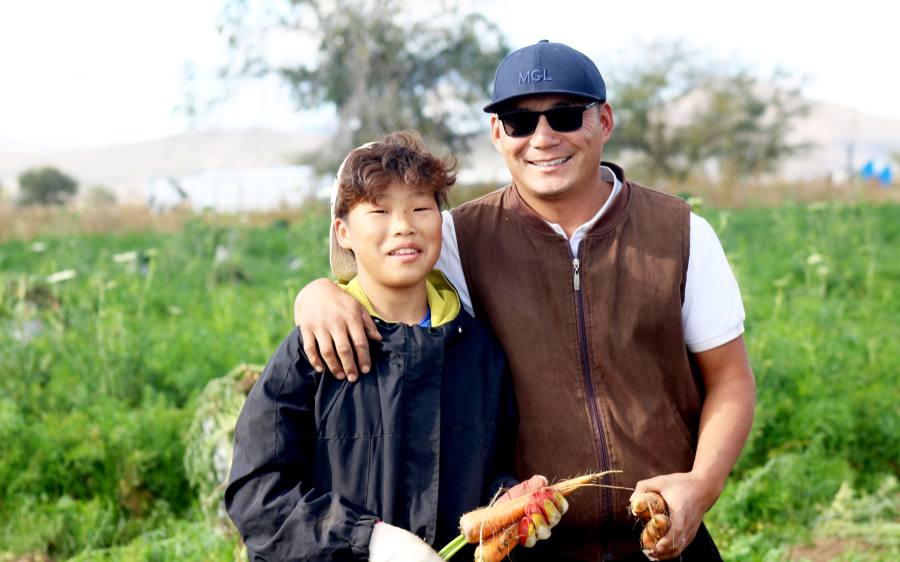
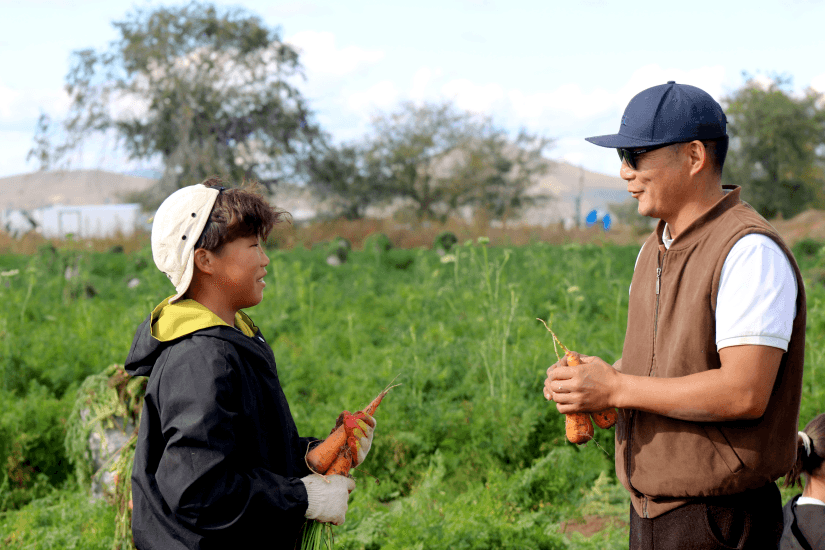
Darkhan, October 1, 2026 /MONTSAME/. Orkhon soum in Darkhan-Uul aimag is rightfully known for its fruits and vegetables. The locals live alongside agriculture through all four seasons: planning in the winter, planting in the spring, tending in the summer, and harvesting in the autumn.

Gan-Erdene G., a local farmer, has worked in the vegetable fields since childhood. After helping his parents plant, water, and harvest crops from the age of six, he now cultivates vegetables on 15 hectares of land annually.
"Helping my parents plant, water, and harvest vegetables brought me great joy as a child. Those memories are still beautiful today," he said. "Now, I am a farmer myself, reaping the fruits of my labor. I am a hereditary farmer."
Before turning to agriculture, Gan-Erdene worked as a teacher. Having worked at a general education school in Orkhon soum, he previously planted seeds of knowledge in children's minds. Today, he plants vegetable seeds in the soil.
"While I used to teach in the educational sector and plant the seeds of education in the children who are our future, I now plant food seeds in the soil. I learned a lot during my time in public service and am glad to have worked with a wonderful team," he said.
The generational labor of Orkhon soum’s farmers is evident in Gan-Erdene’s story. He initially started growing cucumbers and onions on a small plot, but today he cultivates four to five types of vegetables.
 Every year, he farms on 15 hectares and harvests
25-30 tonnes of onions and 15-25 tonnes of carrots. "Although the
harvest volume varies each year, the moment you reap what you sowed in the
spring is the most valuable to a farmer. You feel a sense of relief when spring
planting is done. Then the heavy summer work begins: tending, watering, and
growing the crops. Autumn is the best time. Harvesting what was planted in the
spring is every farmer's joy," he noted.
However, farmers face significant labor shortages during the harvest season. Because the South lacks a steady agricultural workforce, university students are invited to help with the autumn harvest. Since the students must return to their classes, they only work for short periods.
"Students cannot stay for long. They come for the autumn work for a while, work with us, and go back to school. Then we are left with a labor shortage again. But we manage to finish the work we started, adapting to the available workforce and weather conditions," Gan-Erdene said. "For farmers, the climate is a major challenge alongside the labor shortage. Floods, heavy rains, hail, and snow can impact the crops and risk a whole year's labor. Every autumn brings its ups and downs and challenges. Natural factors sometimes bring us to our knees. There are also times when we must sell at low prices. But we have no choice but to work according to market conditions."
Despite these challenges, Gan-Erdene continues his farming and strives to deliver locally grown vegetables to consumers.
 "Some imported
vegetables are easy to recognize, but ordinary citizens might not always
distinguish them. Therefore, people need to know the characteristics and
appearance of Mongolian vegetables. Consumers sometimes focus too much on
appearance. They choose based on shape and size, forgetting about quality.
Mongolian vegetables have their own distinct features. I hope the agricultural
sector, especially the line ministry, pays attention to this and promotes it
through the media to educate consumers," he said.
For Gan-Erdene, autumn is not only the harvest season but also a time that awakens his childhood memories.
"Every autumn leaves beautiful memories. When I was a child, I would drop my schoolbag and run straight to the vegetable field to join my parents," he recalled.
Today, the boy who once ran through the fields alongside his parents has become a farmer himself.