Loading…
Loading…

MONTSAME
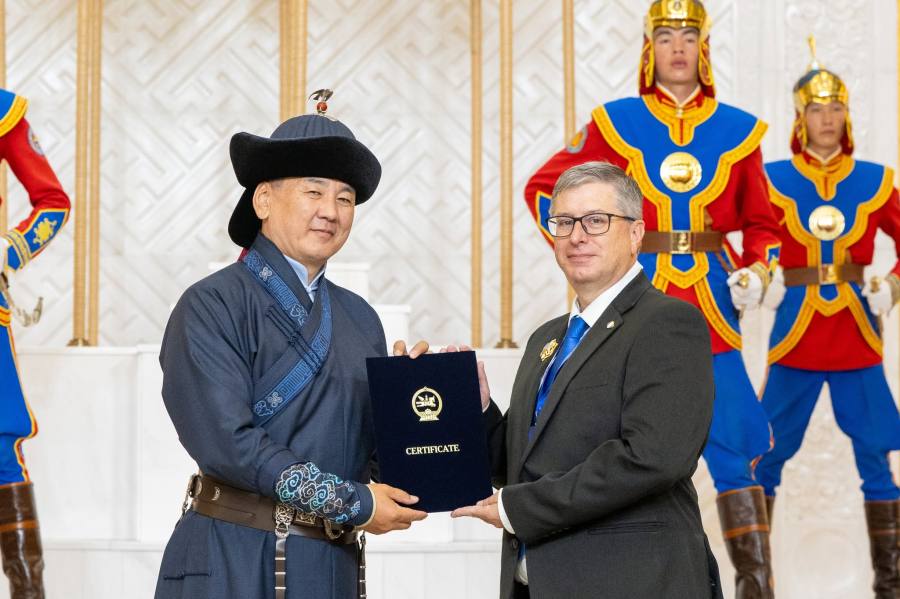
ULAANBAATAR, August 12, 2026 /MONTSAME/ The tactics that carried Chinggis Khaan's armies across Asia still echo on today's battlefields from drone warfare to the premium modern militaries place on mobility and flexibility says Timothy May, a leading historian of Mongol warfare.
May, a professor at the University of North
Georgia and author of "The Mongol Art of War," spoke with MONTSAME on
the sidelines of the 13th International Congress of Mongolists in Ulaanbaatar,
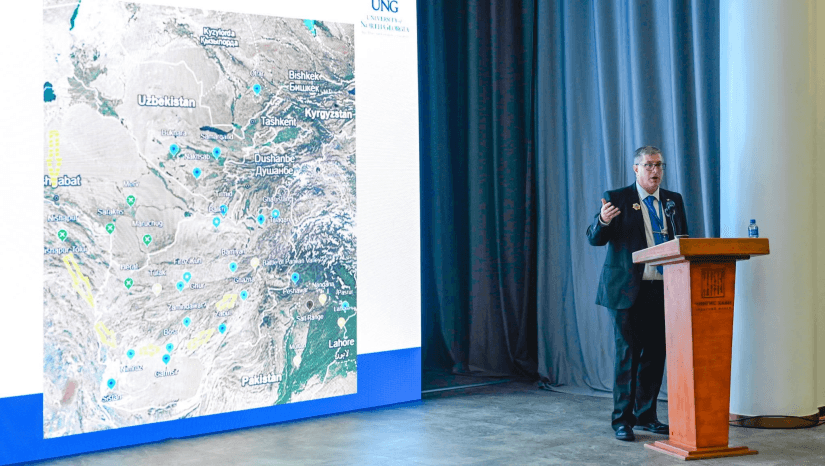
where he presented a paper reexamining the Mongols' 1221 victory at the Battle
of the Indus River.
His work ranges well beyond the battlefield.
May has studied the Tamma, the Mongol military formations that pushed into the
empire's frontier regions to establish control and authority, and his current
research examines how the consumption of food and drink shifted across the
empire and the many regions it absorbed.

- Why was it important for you to study the war tactics of Chinggis Khaan specifically?
- I first became interested in the Mongol
Empire when I was young. As a kid — particularly as a boy — you tend to be
drawn to the military side of things. And as I studied, the Mongols simply made
more sense to me, and captivated my imagination more than other subjects, like
medieval Europe. I found everything they did fascinating.
- How difficult was it to find the research and information on Mongol tactics?
- It was difficult, because you need to know several different languages. There are materials in translation, but some things get lost in the terminology. Different translators choose different words — even in the Secret History of the Mongols, different translations assign different meanings to the same terms, and that can throw off your understanding of what actually happened. So you have to learn Mongolian, Arabic, Persian, Latin, Russian, and other languages. I'm fluent in none of them, and I struggle in all of them. But it's important to be able to read the original languages, because you can't truly understand what's going on if you don't.
- Was there a particular institute or library that proved to be a treasure trove of research?
- The library at Indiana University, where I did my master's, was extremely important — they have an outstanding collection. I also went to Western Washington University, which, outside of the Library of Congress, holds the largest collection of Mongolian-language books, where I found many things I hadn't had access to at the University of Wisconsin. But most important was not just looking at the Mongol period itself, but also at other nomadic and Inner Asian empires, like the Liao, and at what came before — so I could understand how things changed over time, and study other military systems to see what was similar, what was different, and what was unique about the Mongols.
- When you were writing "The Mongol Art of War," was there a question you had that you couldn't find the answer to?
-I'm sure there was. The book grew out of my dissertation — it's essentially the first hundred pages or so. What I was trying to understand was why the Mongol military was so successful, and what made it different. My ultimate conclusion, in some respects, was that the Mongol military resembled a modern military system far more than it did those of its peers — any other state at the time — in terms of its organization and how it operated.
As for unanswered questions, yes. Take the terminology for certain tactics or maneuvers — did they have names for all of them? In most cases, we don't know. When the Secret History mentions something, it often doesn't describe it; it simply names it, which means the people reading it at the time automatically understood what it meant. Other sources describe these things, but sometimes they get them right and sometimes they get them a little confused — and later historians do the same. So you have to work out what is actually correct.
For instance, in the discussion of the Nerge, the encircling maneuver — which of course came from hunting — at some
point it was described as a battue, a French term for a royal hunt, which
actually operates quite differently from how the nerge worked. That led to
confusion about what it actually did, and it was one of the things I had been
trying to figure out. Over the past decade, I've also been trying to work out
things about the Tamma institution, and about the Auginchi — what happens to
them, because they seem to disappear. It's not even a term really used in
modern Mongolia. These are quite fascinating puzzles.
- Some researchers describe how the rise of the Mongol Empire was tied to the environment — that when Mongolia experiences drought, everyone else has plentiful rainfall, but when Mongolia has rain and abundant vegetation, the rest of the world experiences drought. By this account, Chinggis Khaan was so powerful partly because he had plentiful livestock thanks to heavy rainfall, while his enemies were weakened by famine. Does this explanation have any merit?
- I agree with it to a certain extent. But single-cause explanations rarely work out, because there are always other factors. And here's the thing: if everything was so good in Mongolia and so bad elsewhere, why would you want to go to the bad areas? It can be a reason in the sense that they were able to raise many animals and things were going well. But let's not forget that before the Mongol Empire, there were decades of warfare — which also meant many animals dying, whether killed in the course of war or worn down by the constant movement back and forth. So it cannot be explained by environmental factors alone. There are other things going on. The environment is certainly one cause, and we can never rule it out entirely — but it's never the only one.
- My last question: what do you think people get wrong about Chinggis Khaan on a global scale?
- On a global scale, I don't think people realize just how brilliant he was. Part of that brilliance is that, while he of course placed great emphasis on loyalty, he also wanted people who could give him advice — and he asked for it. He would ultimately decide whether to act on it or not, but he was willing to listen to those who criticized or questioned whether something was the right idea. He was open to hearing multiple points of view and to receiving criticism. He also made an effort to reflect on what he had learned — including his mistakes — and to ask whether things could be done differently. I think much of that came from his own life experience.
Most people underestimate him, and part of that, I think, is because he was illiterate. People saw him as a barbarian who destroyed a great deal. But in fact he was very thoughtful about his actions. He could be impulsive at times — but that's true of everyone. Overall, he was very considerate of what he was doing. He thought carefully about the decisions he was going to make, and sought advice before coming to a final decision.