Loading…
Loading…

MONTSAME

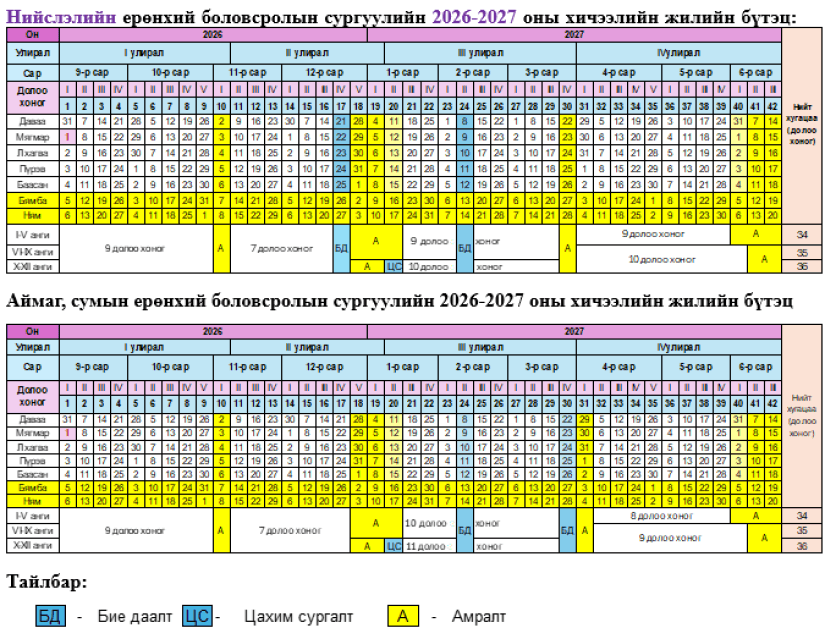
Ulaanbaatar, July 28, 2026 /MONTSAME/. The structure of the academic year for general education schools has been newly approved by Order No. A/211 of the Minister of Education, dated July 8, 2026.
According to Article 5.2 of the Law on Preschool and General Education, the academic year for general education schools runs from September 1 to June 15 of the following year. Furthermore, Article 5.3 stipulates that the total duration of the academic year shall be between 34 and 37 weeks.
Under current regulations, classroom instruction at general education schools lasts for 32 weeks for primary grades, 33 weeks for middle grades, and 34 weeks for high school grades. In addition, two weeks during the academic year are dedicated to both classroom and extracurricular activities aimed at supporting the development and maturation of students. Consequently, the total duration of the academic year spans 34 to 36 weeks, depending on the education level, and is implemented under a three-term structure.
In response to various proposals and opinions from parents, guardians, and teachers regarding the academic year's structure and the schedule of term breaks, a survey was conducted among teachers in May 2026. A total of 9,620 teachers participated and expressed their views.
The survey results revealed that 52.2 percent of respondents proposed shortening the students' winter break by 1-2 weeks, starting the summer break for primary school students on June 1, organizing the academic year into a four-term structure, and bringing forward the start of the summer break for middle and high school students by one week.
Based on these proposals and survey findings, representatives from the Ministry of Education, the General Authority for Education, the National Institute of Educational Research, the Education Departments of the capital city and provinces, and the Trade Union of Education and Science held joint discussions. Together, they developed and approved a unified version of the academic year structure that integrates legal and policy requirements with the suggestions of the stakeholders.