Loading…
Loading…

MONTSAME

Ulaanbaatar, May 13, 2026 /MONTSAME/. MONTSAME National News Agency, in cooperation with MICC Mongolia International Capital Corporation LLC, is delivering weekly updates on Mongolia’s domestic capital markets and economic developments to its readers.
Weekly Capital Markets and Economic Review
(2026.05.04–2026.05.10)
MONGOLIAN STOCK EXCHANGE
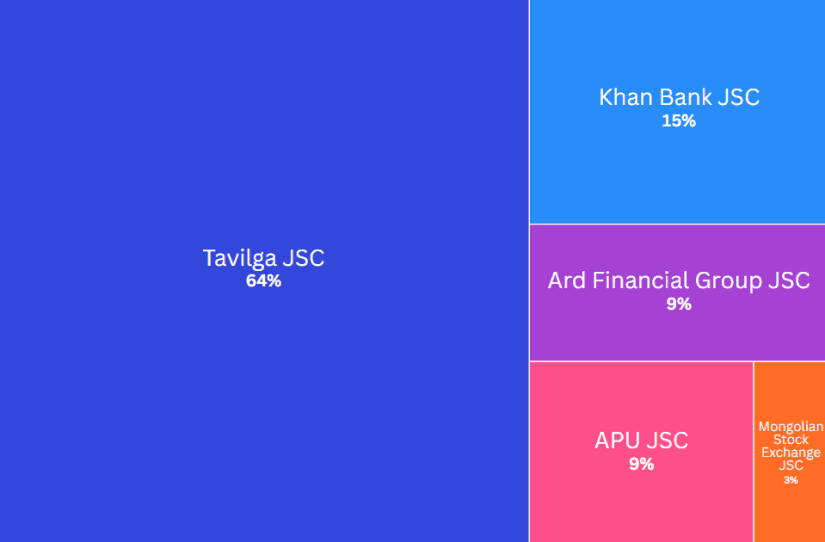
During the week, a total of 6.06 million securities worth MNT 16 billion were traded on the Mongolian Stock Exchange. Among them, Tavilga JSC, Khan Bank JSC, Ard Financial Group JSC, APU JSC, and Mongolian Stock Exchange JSC led in terms of trading value. A total of two block trades were executed during the period.
Last week, the main stock market indices closed with mixed performance, reflecting a short-term correction following previous gains. The TOP-20 index fell by 1.00%, and the MSE A index declined by 0.66%, indicating increased profit-taking and caution among investors in large- and mid-cap stocks. In contrast, the MSE B index rose slightly by 0.13%, suggesting continued selective buying activity in the small-cap segment. Overall, market movements indicate a transition from broad-based growth toward a consolidation phase, with investors reassessing risk after recent gains. While activity in the small-cap segment remains, overall market momentum shows signs of weakening.

BALANCE OF PAYMENTS SURPLUS IN Q1 2026, SUPPORTING TRADE GROWTH
According to the Bank of Mongolia, the country’s balance of payments recorded a surplus of USD 95.5 million in the first quarter of 2026, improving by USD 697.6 million year-on-year. The current account also posted a surplus of USD 412.5 million, up by USD 1.4 billion compared to the same period last year.
Key indicators:
The improvement was mainly driven by the strong performance of the goods trade balance, which reached a surplus of USD 2.4 billion, nearly nine times higher than the previous year. Exports increased by 68.3% to USD 4.8 billion, while imports fell by 7.8% to USD 2.4 billion, significantly widening the trade surplus.
However, pressures remained in services and income accounts. The services deficit increased by 26.7% to USD 1.0 billion, while the primary income deficit doubled to USD 1.1 billion, mainly due to rising dividend and interest payments to foreign investors.
The financial account recorded a deficit of USD 85.8 million, driven largely by outflows in other investment categories. Nevertheless, net foreign direct investment increased 2.4 times year-on-year, indicating sustained investor interest.
Key risks:
Although Mongolia’s external position improved significantly, the gains remain largely driven by commodity exports and import contraction, while structural vulnerabilities persist due to persistent service and income deficits.
TRADE TERMS IMPROVE, EXPORT PRICES OUTPACE IMPORTS
According to the National Statistics Office, Mongolia’s terms of trade index reached 97.1 in March 2026, up 19.3% year-on-year and 0.8% month-on-month, indicating that export prices have increased faster than import prices, improving overall trade conditions.
Key indicators:
Export prices rose by 16.3% year-on-year, driven mainly by increases in gold and copper prices:
Import prices declined by 2.5% year-on-year, easing cost pressures. As a result, purchasing power of export revenues improved, strengthening external trade conditions. High commodity prices—especially for gold and copper—continue to support export revenues and foreign currency inflows, providing short-term support for the balance of payments, reserves, and the tugrik exchange rate.
However, the index remaining below 100 suggests that despite improvements, long-term equilibrium has not yet been reached. Mongolia’s trade conditions remain highly dependent on global commodity price fluctuations.
GOVERNMENT PRESENTS REFORMS TO IMPROVE FOREIGN DEBT EFFICIENCY AND REDUCE TAX BURDEN
At a meeting of the MPP parliamentary group in the State Great Khural, Minister of Finance Z. Mendsaikhan presented updates on foreign debt utilization and proposed tax reforms. As of last year, government external debt reached MNT 35.4 trillion, equivalent to 39.4% of GDP, highlighting the continued importance of external financing.
Allocation of foreign debt financing:
The government stated it will focus future borrowing on high-impact economic and social projects, improve efficiency, reduce wasteful spending, and strengthen fiscal discipline. It also noted that approving small annual borrowing amounts has led to project delays of 5–10 years, increasing overall financing costs, and plans to urgently submit legislation to improve loan utilization efficiency.
Proposed tax reforms include:
The proposed reforms aim to reduce tax burdens on individuals and businesses, support SMEs, and improve economic activity while enhancing the efficiency of public borrowing and fiscal sustainability. Given the still-high level of external debt, debt efficiency and fiscal stability are expected to remain key market considerations going forward.