Loading…
Loading…

Unubold B
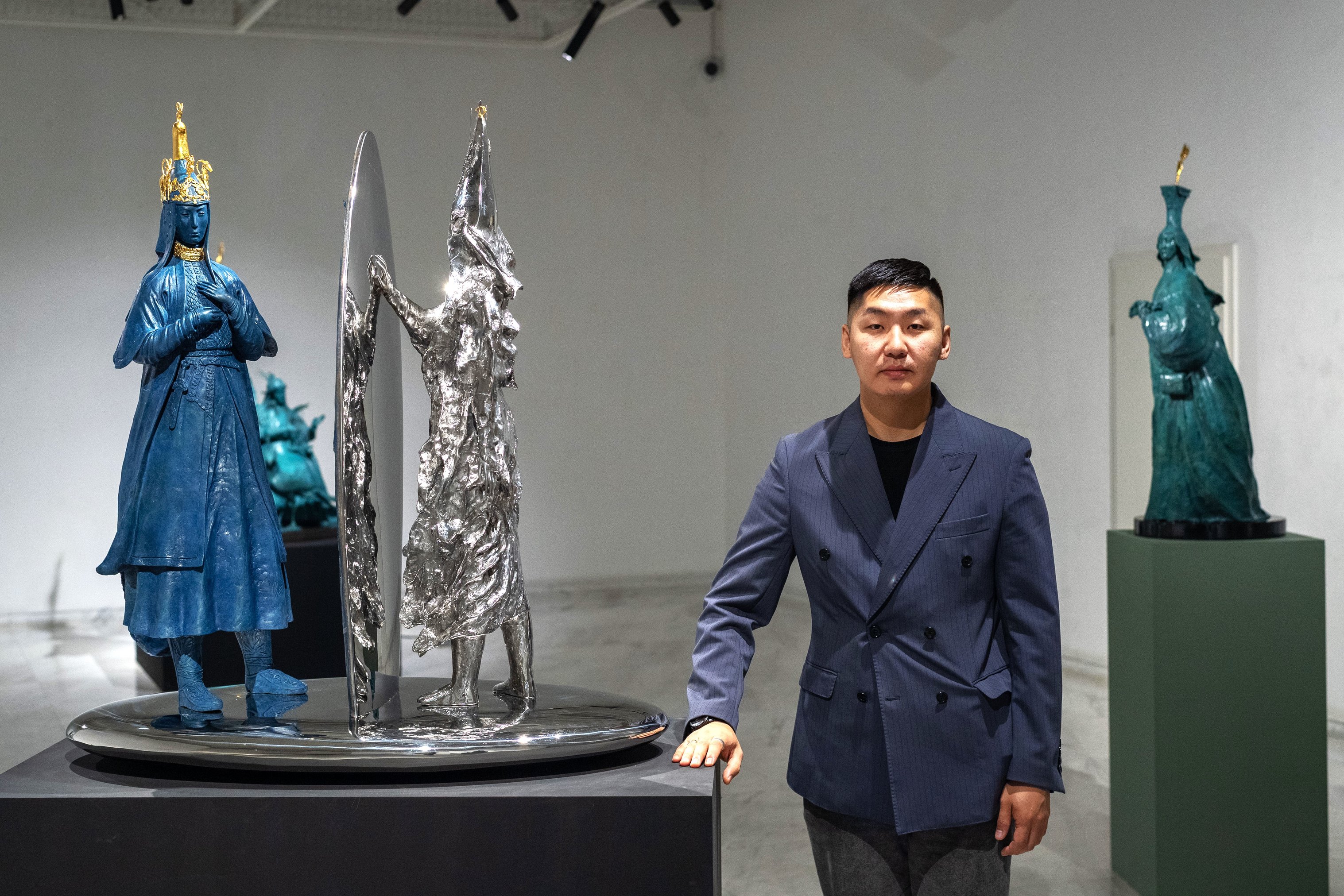
Ulaanbaatar, November 24, 2026 /MONTSAME/. Sculptor Ochirsuren Baterdene studies the history and culture of Mongolia’s ancestors to pass that heritage on to future generations through sculpture. For Ochirsuren, the purpose of working in bronze is to give the surviving traces of the past a lasting form, bringing them to life for people today and preserving them for those who follow. MONTSAME spoke with the sculptor about that ambition, the research behind the sculptures, and the process of making them.
What first gave you the idea for The Legends of the Queens, the exhibition you held last month? Historical accounts often focus on the deeds of the Khaans. What drew you to the stories of the Mongol queens as the subject of your work?
I began studying the history of the Mongol Empire as a university student and became particularly interested in the Mongol queens. I wrote my thesis on their history, studying Alakhai Beki, a daughter of Chinggis Khaan. Later, while working at the Chinggis Khaan National Museum, I had the opportunity to examine archaeological finds and help restore them. That allowed me to take my research further. As I studied objects unearthed in Mongolia and made reconstructions of them, I came to appreciate how important it was to continue that work.
I would say my research began six years ago. I spent the past three years making the sculptures for this exhibition. When we think of our history, we tend to think of Khaans, wars and empires. We often overlook the great queens, mothers and other women behind those stories. The queens played an immense part in raising the Khaans, conducting affairs of state and shaping the civilisation of their time. I wanted people to see that in my work.
Museums also tend to keep garments, accessories and jewellery from the period as separate items. We rarely see them brought together to give us a complete picture of how people dressed and what they looked like.

How many works did you exhibit? Could you describe some that stand out for their composition?
I exhibited seven individual works. Two are fairly large sculptures with several figures. In one, for example, two people, a bird, and an animal appear together in a scene. I wanted to go beyond the portrait of a single person and tell a story through the way the figures move and interact, and through what is happening between them.
A group sculpture like that calls for skill and a fine sense of composition. It takes time to get the figures’ proportions right and to work out the position and movement of each in relation to the others. I spent a year on those two pieces. Sometimes I find myself doing the work of two or three sculptors at once. I walk around a sculpture to see it from every angle, and sometimes I rearrange the figures many times before I settle on the final composition.
I aim to hold an exhibition every year. I plan to work in bronze again for the next one. This time I focused on the Mongol queens. In my next works, I would like to tell the stories of the Mongol Empire’s Khaans, great heroes, generals, and mounted warriors.

What inspired you as you worked on these sculptures? Did music play a part?
Of course. Who doesn’t respond to music? I listen to all kinds of music while I work, and I particularly enjoy classical music. Among composers, I often listen to Sharav Byambasuren. His Sersen Tal (Awakened Steppe) is a wonderful piece. I also listen to a great deal of music by Jantsannorov Natsag.
What inspires me most is our history and the remarkable archaeological finds that bear witness to it. Mongolia has a wealth of history and cultural heritage that is unique in the world. Whenever I get to examine one of those finds, I feel proud of our ancestors.
Music, our history and culture, and the traditions our ancestors passed down to us all inspire my work. I feel I owe them a debt. For me, the most rewarding part of being a sculptor is helping to bring that heritage to life today and pass it on to future generations.

You drew on historical records, archaeological finds, early depictions, clothing and accessories. How did you decide where to draw the line between historical evidence and artistic imagination?
My work is grounded in archaeological finds and historical evidence, so I kept artistic embellishment to a minimum. I tried to depict the objects as faithfully as I could, paying close attention to what they looked like and how they were designed and made.
A sculptor has many ways to convey movement and energy through the pose of a figure, or even to give a sense of wind and air. You can make a figure look powerful and so full of movement that it seems alive. When reconstructing historical objects, I took care to use those techniques in a way that stayed true to the evidence. I relied on what the finds themselves could tell me to recreate the appearance of the period as accurately as possible.

Historical accounts of the Mongol queens are relatively scarce, and their stories are sometimes overshadowed by those of men. Which figure or story surprised you most in the course of your research?
There are relatively few sources on the Mongol queens. The queen I most admire, and the one I have studied most closely, is Sorghaghtani Beki. She was the mother of four Khaans, an honoured daughter-in-law of Chinggis Khaan and the wife of Tolui Khaan. I see her as a wise, far-sighted woman who played an immense role in the history of the Mongol Empire.
At the time, struggles for power and the throne among members of the Golden Lineage sometimes led to bloodshed. Sorghaghtani Beki valued unity and played an important part in reconciling members of the family. She contributed to affairs of state and did much to support education, religion, culture and scholarship. She was also a highly skilled diplomat. When you consider her judgement, her role in government and the way she raised her children, it is hard to overstate her contribution.
How do the queens’ authority, beauty and femininity come together in your sculptures, and how do you portray them as mothers?
I tried to bring all those qualities into my work. I wanted to convey the aristocratic culture of the time through the queens’ beauty, their authority, their commanding presence and the way they moved, as well as through the sumptuous clothes and jewellery they wore.
Above all, I want people today, especially young people, to understand how our ancestors lived. I wanted to show what we have lived through as a people to reach this point and what kind of civilisation we built along the way. The Mongols did not conquer half the world and make their history by the strength of their mounted warriors alone. Behind that history were great queens, wise mothers and women who sustained their civilisation and helped carry forward the policies of the state. That is one of the things I most want people to see in my sculptures.
Sculpture is three-dimensional. A person’s posture, clothing and jewellery can all carry meaning, as can the features of the face. Which visual details did you draw on most to convey the queens’ character and standing?
The queens were noblewomen of the highest rank. Their clothes, accessories and jewellery reflected their standing and authority, and the designs themselves carried symbolic meaning.
For example, the phoenix often appeared on clothing and accessories worn by queens in the 13th century and during the Yuan dynasty. It is a mythical creature that symbolises eternal life and strength. Phoenixes and traditional designs such as the ancient horn-scroll motif appeared on deels and other garments, on bracelets and on gold ornaments. Those designs tell us something about the culture of the time and the meaning people attached to these symbols. I tried to bring that imagery into my sculptures.

What, to you, gives Mongolian sculpture its distinctive language?
Mongolian sculpture has a language and a tradition of its own. To my mind, the earliest examples are the stone statues of human figures. I regard them as one of the great legacies of early Mongolian sculpture. Their makers took extraordinary care to capture the features, beauty, proportions, and bearing of members of the nobility. These statues are a precious inheritance from our ancestors.
The craftsmanship of objects from the Hunnu period is also remarkable. Among the finds from aristocratic tombs at sites such as Gol Mod II are saddles, bridle fittings and breast straps for horses. When you think that people made such intricate, elegant objects more than 2,000 years ago and used them in everyday life, you cannot help feeling proud of our ancestors’ skill and artistry.
In my own work, I try to bring these traditions and their distinctive imagery into the language of contemporary sculpture. I want my sculptures to retain a recognisably Mongolian character and to reflect our way of life, history and culture.
Sculpture is one of the visual arts. How do you understand art more broadly? What does it mean to you?
I think art begins in the human mind. An idea takes shape in your thoughts and imagination, and through your eyes and hands it becomes something tangible. That is why I think artists need to read widely, study all kinds of subjects, and keep learning. An artist should be able to talk to anyone about any subject. I also think it matters how you conduct yourself and what qualities you cultivate in yourself.
The visual arts depend on sensitivity. People do have natural talent, but hard work counts for more. As the saying goes, it is one percent talent and 99 percent hard work. Making a work of art involves much more than what you do with your hands. You keep thinking about the piece, researching it, and considering it from different angles. Only then does it take shape.

Did the experience of presenting a solo exhibition at the Weltmuseum Wien influence The Legends of the Queens in any way? What differences have you noticed between presenting Mongolian history and culture to audiences abroad and at home?
Europe has a long tradition of settled life, and the arts are highly developed there. European audiences are discerning in the way they look at and appreciate a work of art. They respond deeply to the feelings a work evokes.
I think Mongolian audiences bring something distinctive of their own. We come from a nomadic culture and grew up on the open steppe. I think that gives us a certain openness of mind and shapes the way we feel things. Mongolians have a deep attachment to their homeland and a pride in their heritage. As people looked at the sculptures, I felt that connection came to the surface quite naturally and stirred a sense of pride in their ancestors, history, and culture.
Many Mongolian visitors told me, “I feel proud of our heritage.” Others said, “It was wonderful. I have no words.” As an artist, it meant a great deal to me to hear that.