Loading…
Loading…

MONTSAME
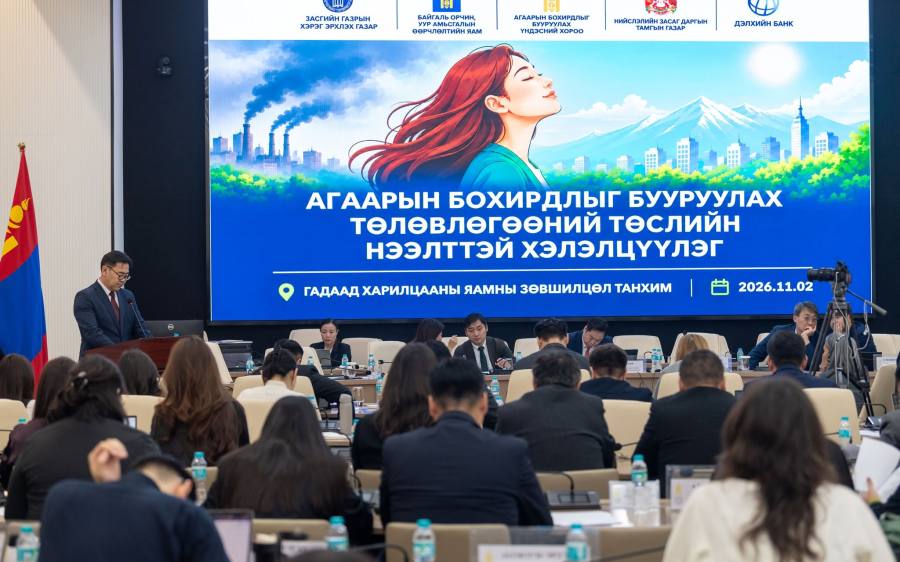
Ulaanbaatar, November 2 /MONTSAME/. A public consultation on the draft 2026–2030 Air Pollution Reduction Plan was held today at the Ministry of Foreign Affairs.
Following the expiration of the National Programme for Reducing Air and Environmental Pollution, Parliamentary Resolution No. 53 instructed the Government to develop and implement a comprehensive short-, medium- and long-term plan addressing all sources of air pollution and ensuring coordination across sectors.
In line with this resolution, a working group was established by order of the Chair of the National Committee for Air Pollution Reduction to develop the draft plan. The working group comprised representatives from the Committee’s Secretariat, 15 ministries and government agencies, and the capital city administration.
The draft plan proposes amendments to relevant legislation, standards and regulations to bring them in line with international practices and improve implementation effectiveness and coordination. In particular, amendments are planned to the Law on Air and the Law on Air Pollution Fees.
The plan also includes 58 measures under seven key areas, including increasing the use of clean fuels among households, promoting energy-efficient consumption, incorporating ger areas into redevelopment projects, improving the reliability and accessibility of energy supplies, and developing thermal and power plants as well as renewable energy sources.
Through the implementation of these measures, the plan aims to reduce air pollution by approximately 55 % from current levels by 2030. Specifically, it sets targets to reduce PM2.5 particulate matter by 66 %, PM10 particulate matter by 77 %, sulfur dioxide by 64 %, and nitrogen dioxide by 15 %.
Speaking to the media during the consultation, Minister of Environment and Climate Change and Deputy Chair of the National Committee for Air Pollution Reduction Sandag-Ochir Tsend said that assessments of the previous five-year plan showed differing results. An independent expert assessment found that air pollution had decreased by 27.4 %, while an assessment by the National Agency for Meteorology and Environmental Monitoring reported a 54 % reduction. Taken together, these findings suggest that air pollution decreased by approximately 30 % over the past five years, he said.
He also said that emissions from the 272,000 households using stoves are the main source of air pollution and emissions from vehicles and industrial and service businesses also contribute to the problem. To address these major sources, a selection process is underway among businesses to increase the supply of improved fuel. He also noted that efforts are being made to expand access to housing.
Members of Parliament, representatives of the United Nations, the World Health Organization, the World Bank and the Asian Development Bank, as well as members of the public and civil society, attended the consultation.
The draft plan is scheduled to be approved at the next meeting of the National Committee for Air Pollution Reduction, to be held next week.