Loading…

MONTSAME
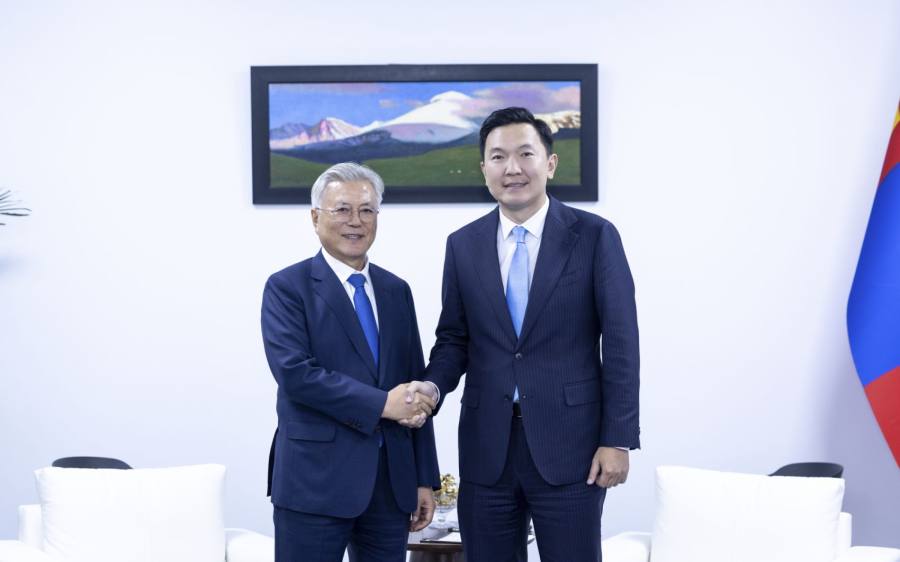
Ulaanbaatar, August 25, 2026 /MONTSAME/. Uchral Nyam-Osor, Prime Minister of Mongolia, met and exchanged views with Moon Jae-in, Former President of the Republic of Korea, who is attending the 17th Conference of the Parties (COP17) to the UN Convention to Combat Desertification.
At the outset of the meeting, Prime Minister Uchral expressed his gratitude to Former President Moon Jae-in for attending COP17 at the invitation of Khurelsukh Ukhnaa, President of Mongolia. The Prime Minister emphasized that relations and cooperation between Mongolia and South Korea have expanded across a wide range of areas, including politics, economy, society, culture, and humanitarian efforts, reaching the level of a "Strategic Partnership." He stated that the Government of Mongolia is implementing the "Chuluulye" (Liberate) national initiative and, within this framework, will fully support the more than 1,200 South Korean enterprises operating in Mongolia. Furthermore, the Prime Minister highlighted the successful implementation of the "Solongo 1 and 2" housing projects. Noting that over 60,000 Mongolian citizens currently reside in South Korea, he mentioned that preparations are underway to establish a second Mongolian school in the country.
Moon Jae-in, Former President of South Korea, said, "Bilateral relations are developing very actively and flourishing. Moving forward, in addition to the rare metals, health, and forestry sectors, we must strive to develop new areas of cooperation. It is important to foster mutually beneficial cooperation in the rare earth elements sector and work together to produce value-added final products. I have heard that Mongolia ranks highly in digital development. We should collaborate in this area. It is also crucial for Mongolian citizens and children residing in our country to preserve their cultural heritage."
The two sides underscored the importance of exchanging technology, innovation, and best practices in environmental protection and combating desertification, as well as enriching bilateral cooperation through concrete, effective projects and programs. Mongolia and South Korea have a long history of fruitful cooperation in mitigating climate change, desertification, land degradation, and yellow dust storms. Mongolia expressed its interest in further expanding collaboration with South Korea to combat desertification, intensify afforestation and ecological restoration, and reduce the adverse impacts of climate change.