Loading…
Loading…

MONTSAME
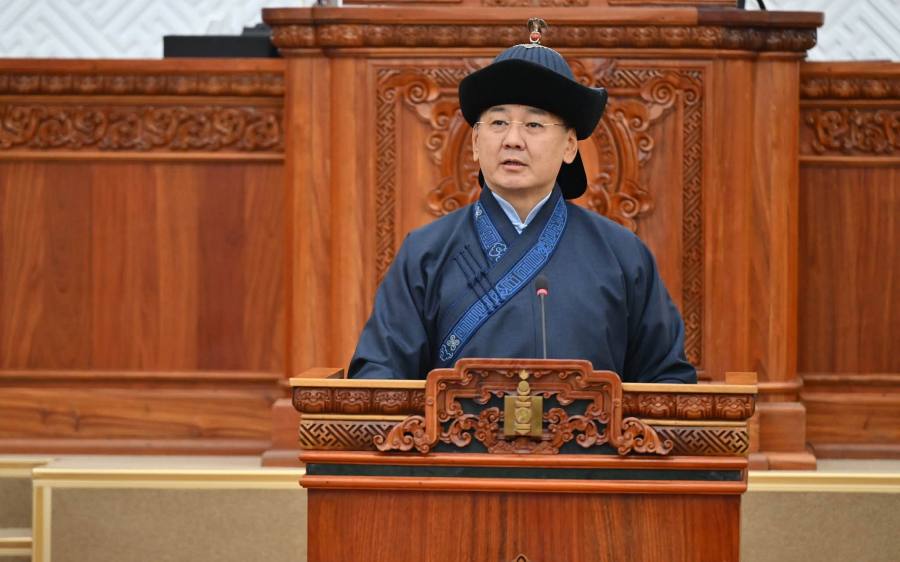
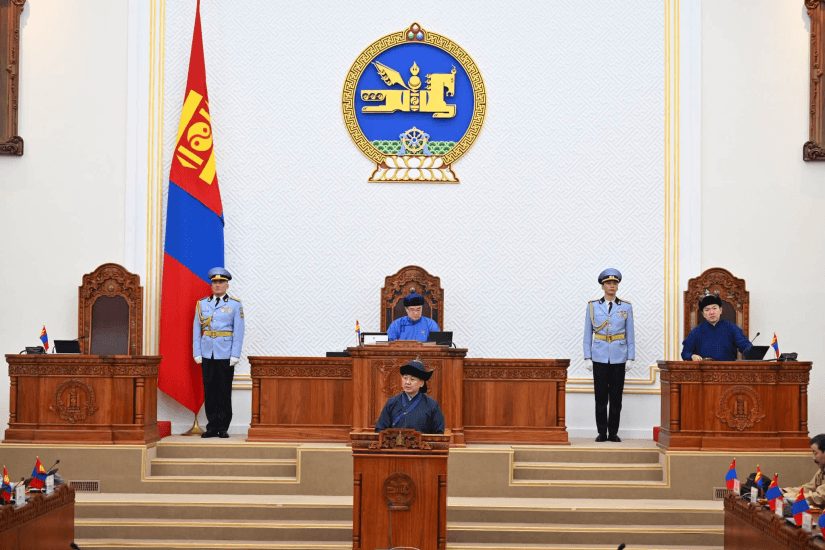
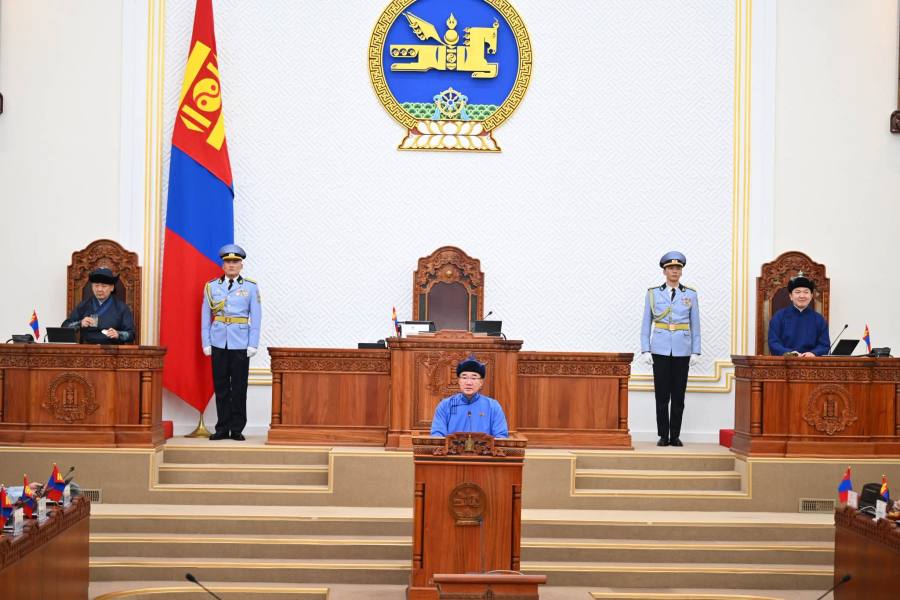
Ulaanbaatar, November 10, 2026 /MONTSAME/. President of Mongolia Khurelsukh Ukhnaa delivered a speech at a commemorative session of the State Great Khural (Parliament) marking the 820th anniversary of the establishment of the Great Mongol State.
Below is the full speech by the President of Mongolia, Khurelsukh Ukhnaa:
Dear citizens of our country, bearers of the hearth of the Great Mongol Empire,
Dear Mongol brothers and sisters living across the world,
Honorable Speaker of the State Great Khural and Prime Minister of Mongolia,
Distinguished members of the Mongol State,
Honorable guests,
I extend my heartfelt congratulations to you on the 864th anniversary of the birth of the Great Chinggis Khaan, an outstanding leader in human history, one of the founders of the world as we know it today, a great figure of the millennium and an eternal source of pride for the Mongol people.
This year, known as the Year of the Fire Horse, or Sureer Daragch in the 17th cycle of the traditional Mongol calendar, marks several historic anniversaries: the 820th anniversary of the establishment of the Great Mongol Empire by Chinggis Khaan, who united the Mongol people under a common system of statehood, history, culture and law; the 840th anniversary of the birth of Uguudei Khaan, the second ruler of the Great Mongol Empire; and the 65th anniversary of Mongolia's admission as a full member of the United Nations.
We, the Mongols, are a people blessed with a great Khaan whose legacy is admired throughout the world and whose memory we will honour for eternity.
Chinggis Khaan is an eternal Great Khaan who represents the guarantee of the independence and continued existence of Mongolia, embodies the values of our people and serves as a source of our national identity and spirit. He is the golden link connecting the spiritual heritage of Mongols across the past, present and future.
Eight centuries ago, Chinggis Khaan was born in the vast Mongol steppe, at the foot of the sacred Burkhan Khaldun Mountain, revered by his ancestors, in the basin of three rivers with their everlasting life-giving waters. He was the eldest son of Yesukhei Baatar, a nobleman of the Mongol steppe, and Oelun Ekh, a wise and discerning mother.
He was an extraordinary man, born with the qualities and abilities of a great ruler. He inherited the tradition of statehood established by his ancestors, the wisdom to govern the state and its people, and earned the hearts and trust of his people.
The half-century-long journey of Temuujin, from uniting the Mongol tribes that had been divided by discord and conflict and establishing the Great Mongol Empire to consolidating the golden thread of statehood inherited from the Hunnu Empire, uniting Khamag Mongol, reviving the sacred hearth of Mongol statehood and being proclaimed Chinggis Khaan, whose name would resound throughout the world, was by no means an easy one.
Chinggis Khaan was abandoned by his relatives and people of the same lineage. From an early age, he endured orphanhood, loss and hardship, which made him resilient. He was unafraid of his enemies, never abandoned his companions, thought broadly, gained wisdom and accomplished great things by establishing the Great Mongol Empire. His is a remarkable story.
Eight centuries ago, Chinggis Khaan and his successors established the Mongol Empire, stretching from the rising sun in the east to the setting sun in the west. They brought an end to centuries of wars and conflicts between the East and West and ushered in the “Pax Mongolica”, or Mongol Peace. This enabled many nations and peoples across Asia and Europe to coexist peacefully, live in harmony, and pursue knowledge, scientific inquiry, creativity and development.
At the time, the Mongol Empire comprised the Ilkhanate, the Golden Horde, the Tsagaadai Khanate and the Yuan Dynasty. According to the Encyclopaedia Britannica, it covered 23 million square kilometres, stretching from the Pacific Ocean in the east to the Persian Gulf and the Danube River in the west, making it the largest contiguous land empire in world history.
It encompassed what are now Central Asia, Iran, Iraq, Russia, Ukraine, Azerbaijan, Armenia, Georgia, China, the Korean Peninsula and parts of Southeast Asia, making it the largest land empire in history.
Thus, the Great Mongol Empire strengthened its unity, consolidated its statehood, governed its people under the rule of law and established peace across the world. It expanded into an empire whose power was admired throughout the world and left an extraordinary legacy in human history, with two centuries of world history remembered as the “Mongol Centuries”.
As a result, peoples across the world came to recognise one another's values, while different civilisations coexisted. Postal relay systems, transport routes, diplomatic relations, trade, economic activity, science, culture and the arts flourished. Ideas of religious freedom and the principle of the rule of law also took shape.
It is therefore with pride that we recall on this festive occasion that, in 1995, The Washington Post named Chinggis Khaan the “Man of the Millennium”, recognising how he and his successors overcame political, economic, religious and civilisational conflicts, which continue to confront humanity today, eight centuries ago, and established the “Pax Mongolica”.
Dear people of Mongolia,
In 1220, Chinggis Khaan issued an edict to establish Kharkhorum, the capital of the Great Mongol Empire, in the vast valley of the Orkhon River, the sacred hearth of the Mongol people.
The valley of the Orkhon River was home to the capitals of the Hunnu Empire, the first nomadic state, as well as those of the Rouran Khaganate, Turkic Khaganate, Uyghur Khaganate and Great Mongol Empire. It is a land that holds the sacred roots of our country's history, culture and statehood.
Uguudei Khaan, the son of Chinggis Khaan, continued and led his father's great undertaking of developing Kharkhorum with distinction. The city's fame spread throughout the world during the reigns of Guyug and Munkh Khaans.
In addition to Mongols, Kharkhorum was home to envoys, scholars, craftsmen and merchants from many nations across the world, including Chinese, Jurchen, Tangut, Khitan, Korean, Tibetan, Uyghur, Persian, Indian, French, German, Hungarian and Russian communities.
The Khaans of the Great Mongol Epire Uguudei, Guyug and Munkh resided in Kharkhorum, where they made all major decisions concerning the lands under their control. These included granting local rulers the authority to govern their own territories, appointing officials to administer foreign lands, conducting population censuses, determining tax obligations, and deciding matters of peace and war with other countries.
Thus, matters affecting the fate of numerous countries were decided in Kharkhorum. From the “Scribes' Office” at the Great Khaan's palace, royal decrees and letters were sent to countries around the world in various languages, including Mongolian, Persian and Latin, establishing diplomatic and other relations.
Letters written by Mongol Khaans, which serve as historical evidence of these exchanges, are preserved in archives, museums and libraries across the world to this day.
Furthermore, the ceremonies for enthroning a Great Khaan of the Great Mongol State were major events attended by envoys from numerous countries.
For instance, in 1246, a grand ceremony to enthrone Guyug as the Great Khaan was held at the Yellow Palace near Kharkhorum. More than 4,000 envoys attended, including the Papal envoy Giovanni da Pian del Carpine, Russian Prince Yaroslav, nobles from China and Korea, two Georgian princes and an envoy of the Caliph of Baghdad.
Even this single example demonstrates that Kharkhorum was not merely a city where matters concerning countries around the world were decided, but also a world capital.
One of the clearest examples of the Great Mongol Empire's founding principles under Chinggis Khaan was its policy of respecting the existence of other peoples rather than imposing its own culture and religion by force.
In the capital, Kharkhorum, 12 religious institutions, including Buddhist, Christian and Islamic temples and places of worship, coexisted and operated freely. During the reign of Munkh Khaan, representatives of different religions gathered there and held debates, an event considered unprecedented in world history.
By developing and ensuring the security of the Silk Road, Chinggis Khaan and his successors connected the capital of the Great Mongol Epire, Kharkhorum, with Western countries through trade. Paper money was introduced into circulation, making a significant contribution to the development of the world economy.
With the lands, political systems and economies of Eurasia united under the rule of the Great Mongol State, the cultural and ideological barriers separating countries and regions gradually fell. Humanity was shown, for the first time, that different peoples could coexist with mutual respect.
In its resolution commemorating the 800th anniversary of the establishment of the Great Mongol Empire, the United Nations General Assembly praised the contribution of the Mongols to human history, stating:
“We recognise the important role played by the Mongols in absorbing the cultural traditions of both East and West, becoming a meeting point of human values and a bridge connecting world civilisations, developing extensive trade networks, establishing major administrative, cultural, religious and commercial centres, and promoting interaction and dialogue among all forms of civilisation.”
On the occasion of the 800th anniversary of the establishment of the Great Mongol State, former President of the Republic of Korea and Nobel Peace Prize laureate Kim Dae-jung assessed the historical significance of Chinggis Khaan's achievements as follows:
“First, he established land and maritime routes connecting East and West. Second, he played an important role in the spread of Christianity and Islam to the East. Third, he facilitated the spread of geography, astronomy, mathematics and cartographic technology to the West. Fourth, by intensifying cultural and economic relations between East and West, he changed the course of future global development.”
Meanwhile, President of the Republic of Türkiye Recep Tayyip Erdoğan wrote:
“Established in 1206, the Great Mongol State was the largest contiguous land empire in world history.
It undoubtedly influenced the course of human development. Chinggis Khaan was not only the leader who established the largest empire in history, but also a great military commander capable of governing a mighty state.
Remembered in the histories of many peoples, whether friends or enemies, for his conquests, the determination and exceptional military skills of the great Chinggis Khaan brought tremendous achievements to the Mongol Empire.”
Former US President Bill Clinton also emphasised that “Since Chinggis Khaan united the Great Mongol Empire in 1206, the Mongol people have deeply cherished independence and freedom.”
French President Jacques Chirac described Chinggis Khaan and his legacy as follows:
“We have yet to fully study and understand just how highly cultured, far-sighted and influential in shaping his society and era this great conqueror, who once shook the world, truly was.
Chinggis Khaan dismantled the tribal system and established national unity, laying the foundations for the eternal existence of the Mongolian nation across generations.
He established peace, ensured the security of the ancient Silk Road and created opportunities for the development of trade, intellectual exchange, and cultural and artistic relations.
As historians acknowledge, one of the important legacies left by Chinggis Khaan, the ‘Pax Mongolica’, created the conditions for relations between Europe and Asia to flourish for centuries.
Today, Chinggis Khaan has become a legendary figure, and his power and memory continue to inspire both awe and admiration across generations.”
In 2006, Pope Benedict XVI wrote:
“Although humanity has undergone considerable changes in its development since 1206, the contribution made by Chinggis Khaan to the Great Mongol Empire and its relations with other civilisations undoubtedly remains significant.”
During his State Visit to Mongolia in 2023, His Holiness Pope Francis XIV, Head of the Vatican City State, highly praised Mongolia's efforts and contributions to global peace and stability. He called on the international community, saying:
“In a world afflicted by conflict, may the Pax Mongolica be established once again, and may countries respect and uphold international law and norms, as they did in those distant times when there was no conflict or confrontation.”
He also stated:
“Mongolia is a country that symbolises freedom of thought and religion, as these fine sensitivities of the spirit and faith are deeply embedded in every aspect of the essence of your culture.”
President of the Russian Federation Vladimir Putin said that “The Mongol state, whose foundations were laid by Chinggis Khaan, had a profound influence on the course of world history.”
German Federal President Frank-Walter Steinmeier described Chinggis Khaan as “one of the most influential and powerful leaders in world history”, adding that “his power should be examined from many different perspectives.”
Japanese Prime Minister Junichiro Koizumi cited the assessment of Japanese scholar Hidehiro Okada, who argued that world history began with the emergence of the general concept of “the world” during the Mongol Empire's rule over the Eurasian continent. Koizumi further stated:
“Considering the policies pursued by Chinggis Khaan, including appointing talented and educated foreigners to high-ranking positions, introducing a common currency and ensuring freedom of religion, the Mongol Empire was a pioneer of globalisation.”
All these assessments clearly demonstrate that the world recognises and acknowledges the Great Chinggis Khaan and the Great Mongol Empire for promoting unity, establishing peace under the rule of law, advancing democratic principles that upheld religious freedom and equality, developing trade, communications, culture and science, and establishing the practices of exchanging envoys and diplomatic service. They laid the foundations for the values, ideas and globalisation that shape the world today.
Furthermore, international scholars and experts advise that studying how Chinggis Khaan and his successors established the “Pax Mongolica”, as well as examining their foreign policy and diplomatic history, offers many valuable examples and lessons.
Therefore, Mongolia has called upon the international community from the distinguished podium of the United Nations, declaring that if countries around the world achieve mutual understanding and cooperation, it is possible to establish global peace in our time, inspired by the principles of the “Pax Mongolica”, which enabled countries to coexist peacefully eight centuries ago and laid the foundations for human development and prosperity.
As a country that consistently pursues a peaceful, open, independent and multi-pillar foreign policy, Mongolia respects the diversity of perspectives arising from the histories, cultures, civilisations, religions, fundamental national interests and development paths of countries around the world. We strive to build international relations based on the principles of a multi-pillar approach.
During the 65 years since Mongolia became a full member of the United Nations in 1961, our country has remained an active and responsible member, making tangible contributions to international peace and sustainable development.
Mongolia has consistently supported the UN's efforts to strengthen international peace and security, including initiatives on disarmament and non-proliferation, and declared its territory a nuclear-weapon-free zone.
We have also sought to establish a dialogue mechanism in Northeast Asia, participated in UN peacekeeping operations, and actively cooperated at all levels by putting forward numerous proposals and initiatives to advance development policies and goals concerning social and economic development, the environment and climate change.
Over the past more than 20 years, Mongolia has deployed more than 20,000 peacekeeping personnel to conflict hotspots around the world, serving the cause of international peace and security.
During this period, Mongolia established diplomatic relations with all 192 member states of the United Nations. During his visit to Mongolia in 2022, UN Secretary-General António Guterres described our country as “a symbol of peace in a world torn by conflict”. This is a high recognition of Mongolia's contributions and efforts in support of the work of the United Nations and its mission of peace.
Today, Mongolia's foreign relations and cooperation continue to expand, while its international standing grows stronger with each passing day. It is a pleasure to note this on today's historic occasion.
Dear citizens of Mongolia, who safeguard the hearth of the Great Mongol Empire,
A nation's unity and cohesion are founded on having books and knowledge to enlighten the mind, a proud heritage to behold and shared values to cherish.
For this reason, with the aim of preserving and promoting the remarkable history and heroic achievements of our ancestors and passing them on to future generations, I, as President of Mongolia, have issued a series of decrees and initiatives.
These include respectfully displaying the portrait of the Great Chinggis Khaan; restoring and developing the ancient capital of Kharkhorum; honoring and promoting the morin khuur, a symbol of national pride; commissioning a comprehensive 30-volume history of Mongolia; and creating a portrait of Chinggis Khaan in every aimag.
We have also established a museum dedicated to our Great Khaan, designated Kharkh Zurkh Mountain, where the name Chinggis Khaan first resounded throughout the world, as a state-worshipped mountain, and created the Golden Statue of the Great Chinggis Khaan, the Great White Banner and the State Seal of the Mongol Empire. These sacred symbols have been ceremoniously installed at the Chinggis Khaan National Museum and made objects of reverence for the Mongol people.
Furthermore, we have brought to the public works such as The Secret History of the Mongols with Detailed Commentary, the Official English Translation of The Secret History of the Mongols, The Wisdom and Teachings of Chinggis Khaan, Studies on the Name “Mongol”, the 15-volume Mongolian Linguistics series and Research on State-Worshipped Mountains.
I am also pleased to note that, at the initiative of the President of Mongolia, the International Association for Chinggis Khaan Studies was established in 2023.
Our ancestors, the Mongols, rose to great power and glory in human history, and the Mongol horse played an exceptionally important role in their achievements.
It is impossible to imagine the Mongol people or Mongol history without their horses. The Mongol people and their horses share one soul.
Therefore, with the aim of preserving and protecting equine heritage and traditions and promoting their role and significance in human life, I initiated the establishment of World Horse Day. The United Nations General Assembly supported and adopted the initiative, establishing the welcome tradition of celebrating World Horse Day around the world during our National Naadam Festival. I am pleased to highlight this achievement on this historic occasion.
History is the foundation upon which we reflect on our past, shape our present and build our future. It is also the collective memory of our statehood.
In recent years, at the initiative of the President of Mongolia, exhibitions showcasing Chinggis Khaan's legacy, the role of the Mongol people in world history and the richness of our cultural heritage have been successfully organised in cooperation with partner countries, including Germany, France, the Czech Republic, Switzerland, Russia, the United Kingdom and Japan.
Furthermore, the state policy to restore and develop the ancient capital of Kharkhorum is being successfully implemented. May the city of Kharkhorum rise once again as a symbol of the unity and strength of the Mongol people and a harbinger of a prosperous era, enduring forever as the golden link between our past, present and future, and may the sacred hearth of Mongol statehood flourish for generations to come.
The wise words of the Great Chinggis Khaan, in which he declared that the Great State must always be cherished above one's own life, should remain forever in the hearts of our people:
“Though my body may grow weary, let it be so; May my state never perish. Though my whole body may suffer, let it suffer; May my united nation never fall apart.”
On this festive occasion, I call upon every citizen of Mongolia to honor, revere and cherish Chinggis Khaan; to protect our freedom, independence and national unity as dearly as the pupils of our eyes and the core of our hearts; and to remember every morning, strive every day and reflect every evening on the fact that we are the successors of the Great Mongol Empire established by our ancestors.
I extend my heartfelt congratulations to all Mongols, descendants of the Great Khaan, on the 864th anniversary of the birth of our Great Chinggis Khaan, the Man of the Millennium and one of the founders of the world as we know it today, the “Mongol Pride Day”, and the 820th anniversary of the establishment of the Great Mongol State.
May the might and glory of our Great Khaan protect the Mongol people for eternity under the Eternal Blue Sky.