



‘Kherlen’ Meteorite Drawing Global Scientists’ Attention
Environment
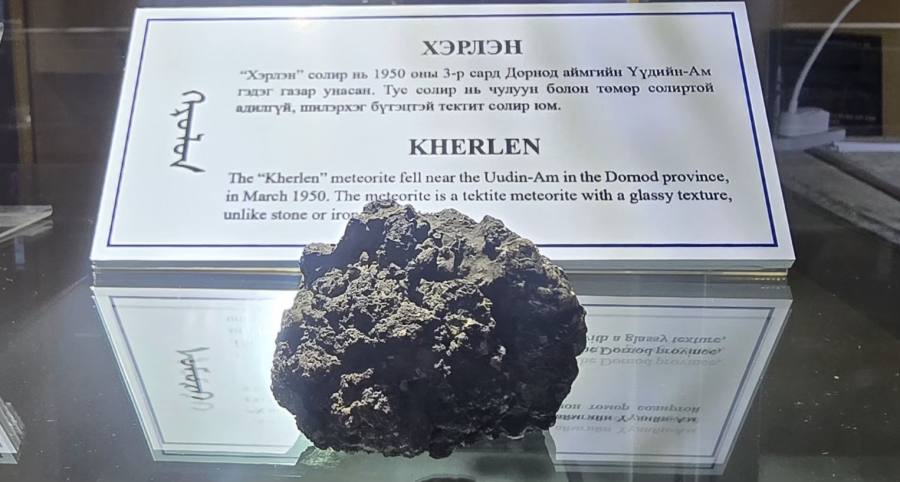
Choibalsan, April 9, 2026 /MONTSAME/. The “Kherlen” meteorite is one of the meteorites that has attracted the attention of scientists worldwide. Preserved at the Natural History Museum, this specimen is a tektite meteorite with a glass-like structure, unlike typical stony or iron meteorites.
At around 1:00 a.m.
on March 22, 1950, the meteorite fell about 80 km south of the Kherlen River,
at a place called Uudiin-Am in Dornod aimag. Many local residents witnessed the
incident and described a loud noise and a bluish-green flame as it descended.
Upon impact, it melted thick snow in the surrounding area, burned vegetation
over an area roughly the size of a traditional ger base, and created a
deep crater where it embedded into the ground.
Named “Kherlen,”
the meteorite weighs 32.7 kg and measures approximately 2 meters in length and
over 1 meter in width. It has a rounded, relatively thin form with a glossy, enamel-like
underside. Its appearance is glassy, brownish-green in color, and it is a
lightweight yet hard metal rock.
Similar meteorites
had previously been found in countries such as former Czechoslovakia, former
Soviet Union, the United States, Ivory Coast, South Asia, and Australia. However,
since none had been directly observed falling, scientists had long debated
whether they were truly meteorites. The “Kherlen” meteorite provided crucial
evidence which confirmed that such tektites are indeed of extraterrestrial origin.
Additionally,
in 1969, samples of lunar soil brought back to Earth during the Apollo 11 Moon
Landing contained rock material with a composition similar to these glassy
meteorites.