



Purpose of Nationwide Deliberative Polling ‘Mongolians – Stewards of Their Wealth’
Politics

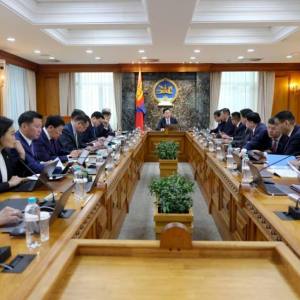
Ulaanbaatar, March
27, 2026 /MONTSAME/. By Resolution No. 48 of 2026, the Government of
Mongolia has decided to organize a nationwide deliberative polling, “Mongolians –
Stewards of Their Wealth,” aimed at engaging citizens and building consensus on
how to centralize revenues from natural resources into the National Wealth Fund
and ensure their fair and equitable distribution to both current and future generations.
The polling seeks to identify solutions for increasing the fund’s income, growing
its assets, and ensuring proper and efficient spending.
The first stage of the Deliberative Polling will be conducted nationwide from March 27 to April 3, in cooperation with the National Statistics Office. The second stage will take place on April 11-12 at the State Palace in Ulaanbaatar. The sampling methodology has been developed and approved by the National Statistics Office in accordance with international standards. A total of 1,570 citizens will participate, including 740 from Ulaanbaatar and 830 from the rest of the nation.
As part of the preparatory process, the following has been conducted to ensure a balance of information, increase awareness of issues surrounding the National Wealth Fund, and ensure diverse opinions are being reflected in the information on policy options:
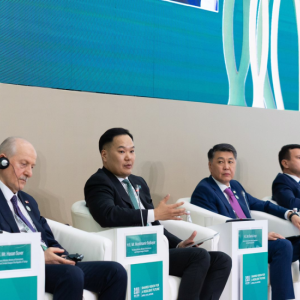
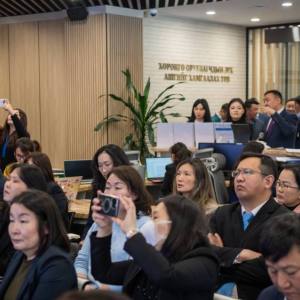
- Research Conference on “Current State and Challenges of the Wealth Fund” involving researchers, academics, and policymakers (March 17)
- Consultation with representatives of the mining sector (March 26)
- Consultation with participants from the banking and financial sector, as well as young researchers and scholars (March 27)
These discussions focused on the current situation, key challenges, potential improvements, and policy solutions related to the National Wealth Fund.
.
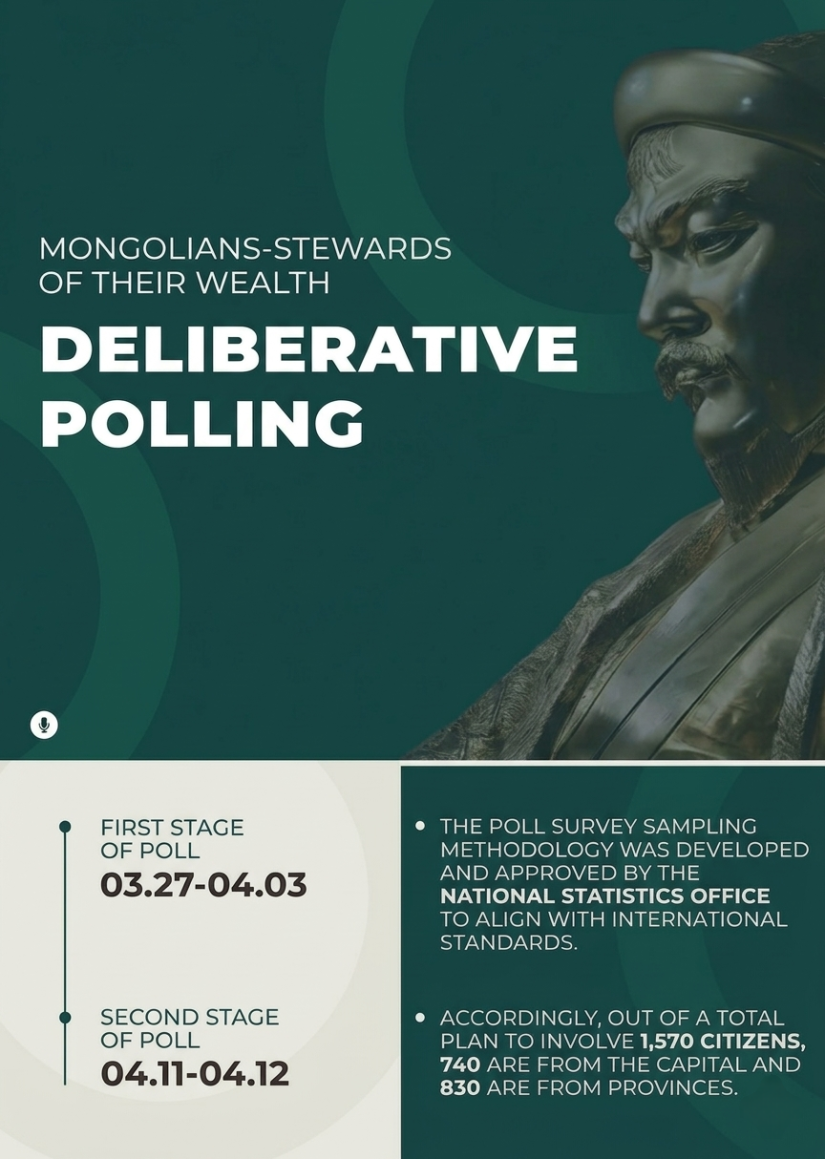
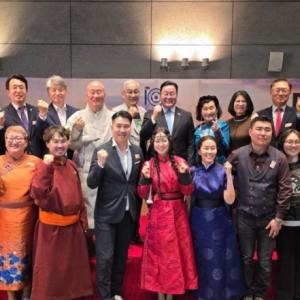
“Mongolians-Stewards of Their Wealth” Deliberative Polling.
Within the framework of the National Wealth Fund, several key policy issues have attracted public attention. These include:
- Ways to balance current spending needs and long-term savings
- Ways to define fair mechanisms for distributing benefits to citizens
- Ways to establish governance and oversight systems that ensure transparency and accountability
In
this context, the nationwide deliberative poll holds particular importance. It
provides citizens with balanced information, an opportunity to discuss policy
options, and a platform to express informed opinions on
the management of Mongolia’s natural wealth.
Notably,
citizen participation in decisions that directly affect their lives is highly
significant. The deliberative polling effectively places the decision-making
process in the hands of citizens, creating an opportunity for their voices to
be reflected at the policy level. This principle forms the foundation for
citizens to be true owners of their wealth, to benefit equitably from natural
resources, and ultimately to ensure that future generations live in a better
society.
Moreover, capital- and return-based
markets are gradually developing in Mongolia. The previous practice of the “1072
shares” gave us an understanding that citizens can directly benefit from national
wealth and use their portion for their own needs. Within the framework of the National
Wealth Fund reforms, if the system is implemented effectively, citizens will
not only receive higher returns but also have a voice in their management and
expenditure.
International experience highlights the importance of strong governance in managing natural resource wealth. The International Monetary Fund emphasizes that transparency and good governance are essential for fair and sustainable management of resource revenue. The World Bank stresses the importance of accountability and oversight in effective sovereign wealth fund management. Research shows that a lack of transparency in extractive industries increases risks of corruption and mismanagement, and studies by the OECD and others demonstrate that citizen participation improves policy quality and strengthens public trust in government.
Mongolia’s earlier experience of
deliberative polling proved that, given the right information and a
well-organized environment, citizens can ensure active and quality
participation. Deliberative polling is not merely a process of collecting
opinions; it is an important mechanism for strengthening the legitimacy of
democracy and building consensus at the national level.
Thus, citizen participation is
significant to the successful implementation of the National Wealth Fund, and its
outcome will determine how Mongolia will manage its wealth in the future.
Researchers believe that investing
the revenues accumulated in the National Wealth Fund in the primary needs of
the people, such as health, education, and accommodation, through the Future Heritage
Fund is an optimal solution. For instance, the returns of Norway’s sovereign wealth
fund, “Government Pension Fund,” finance the country’s health, education, and
infrastructure sectors, ensuring long-term sustainability.
Studies indicate that investment in policies
aimed at improving human development, i.e., health, education, and quality of
life, is the foundation of economic growth, social stability, and equality. Thus,
a wealth fund serves not only as a savings tool but also as an investment
mechanism aimed at improving citizens’ well-being.
All of this aligns with the fundamental
principles of the “Tsegtsrekh” (“Orderly”) Movement, proposed by Prime Minister
Zandanshatar Gombojav, forming the basis for translating economic growth into
tangible improvements in citizens’ quality of life.
Citizens’ participation is crucial in
the successful implementation of the National Wealth Fund. The results of the
process will define how Mongolia will manage its wealth in the future, forming
the conditions for citizens to become stewards of their wealth.
In other words, your voice as a
citizen is of the utmost value in the “Mongolians—Stewards of Their Wealth” deliberative
polling.
What is the significance of conducting a deliberative
poll?
Nationwide
deliberative polls were organized in Mongolia in 2017 and 2023, respectively.
The government will now consult with citizens on the issues of increasing the
income of the National Wealth Fund and distributing the benefits of natural
resources more equally and fairly to the citizens.
Researchers
consider deliberative polling to be a methodology for the practical
implementation of deliberative democracy—a form of democracy where deliberation
or discussion plays a primary role in the political decision-making process. In
other words, this methodology is a democratic procedure that allows citizens,
selected through random sampling, to express their positions after receiving
balanced information on a given issue, asking questions of experts, and
discussing the matter among themselves. It is characterized by the fact that
citizens not only vote, but also participate in an information-based,
deliberative decision-making process.
DETAILED EXPLANATION: Deliberative polling is a comprehensive activity to involve citizens in state affairs by obtaining opinions through specially prepared questions from citizens selected by random sampling. This occurs before decisions are made or regarding the implementation and compliance of existing decisions by decision-making authorities on issues affecting the public interest—including all levels of legislative and executive power, other public law entities authorized by law to issue administrative norms, and local self-governing bodies at all levels. Relevant legislation states that the purposes of a deliberative poll are: 1) To identify pressing socio-economic issues with the assistance of citizens, 2) To consult with citizens regarding the prioritization of the issue, methods for its resolution, and the decision to be made, 3) To provide knowledge and information to citizens and the public regarding pressing issues, and 4) To ensure the participation of citizens in state affairs as specified in the Constitution of Mongolia. (Law on Deliberative Polling)
Principles of the
Wealth Fund
The 2019
amendments to the Constitution of Mongolia legislated the principle of citizens
receiving equal and fair benefits from natural resources. However, as of today,
this principle is not fully implemented, and the fact that citizens are only
receiving a certain portion of the benefits remains a pressing issue.
Within the
framework of the National Wealth Fund, MNT 6 trillion has been concentrated in
the Future Heritage Fund and approximately MNT 1 trillion in the Accumulation
Fund, with the gap between these funds reaching MNT 5 trillion.
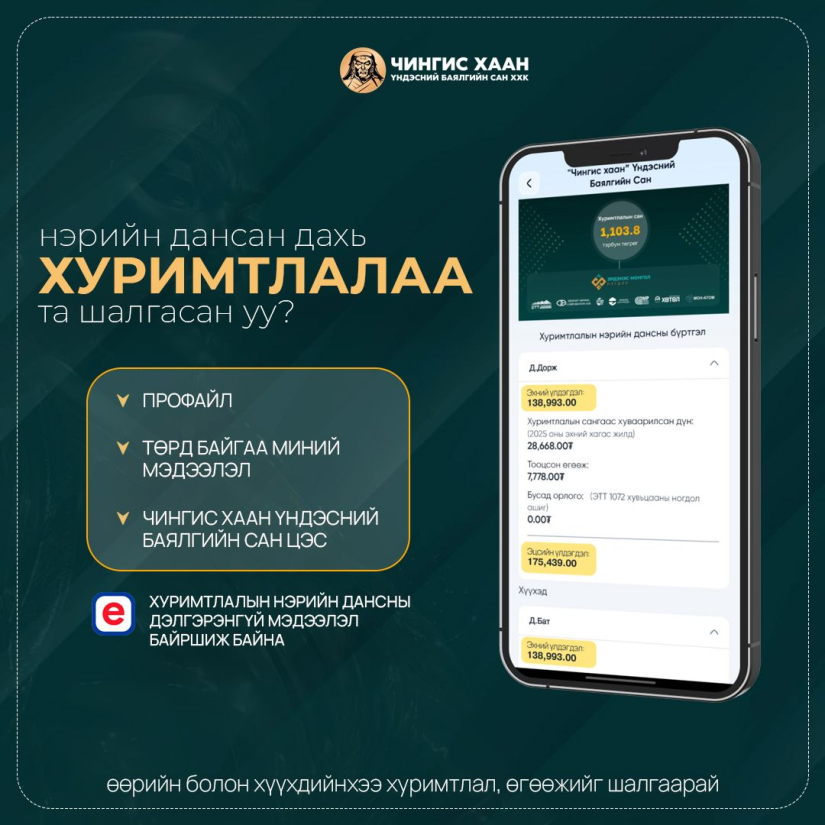
Furthermore,
although every citizen now has a nominal account in the Accumulation Fund, the
average balance is MNT 175,000, which indicates that the principle of equal
distribution of wealth benefits is being lost.
The
"Mongolians – Stewards of Their Wealth" deliberative polling organized
by the Government will focus on making the National Wealth Fund policy and the
distribution of natural resource benefits more fair, transparent, and
accessible based on citizen participation. This will be an important step
toward strengthening the management system of natural resource income according
to transparent and clearly established methodologies and regulations,
ultimately making it beneficial for citizens in the long term. It will also
create the opportunity to turn the implementation of the law related to Mineral
Resource Royalties (AMNAT) into a reality.
The National Wealth Fund will establish the foundation of the system for distributing, accumulating, and spending income derived from natural resources. It will operate according to the principle that wealth is the property of the people and must take into account the public interests of both current and future generations.